The State of Work with David Weintraub (New York and New Jersey)
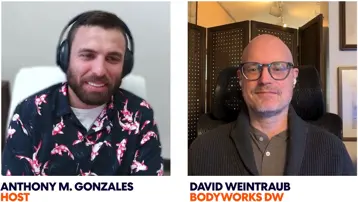
Join us as we explore how to scale a hands-on, hyper-physical service business with David Weintraub, Founder of Bodyworks DW Advanced Massage Therapy, a two-studio medical massage practice in Manhattan. Discover insights on niching down, surviving COVID's existential threat to in-person work, why guaranteed income beats commission-only in the long run, and how AI overviews are quietly rewarding businesses that publish deep, specific expertise.
0:00 — Anthony: Where are you calling in from? Where's home base?
0:12 — David: Home base is Brooklyn. I live in Brooklyn with my wife. Our studios are in Manhattan — we have two studios, one in Financial District, one in Midtown. My home office here, where I do a lot of admin stuff and these kinds of things from time to time, is out in Kensington, Brooklyn.
0:36 — Anthony: I would love to learn the journey and the pathway that led you to your current role. Where did you start out? Maybe where'd you go to high school and it's like the 60 seconds and here I am today.
0:46 — David: Okay. High school was Hillsboro, New Jersey. It's actually semi-relevant in the sense that I had my first introduction to massage therapy during high school. I took an intro to shiatsu course at the YWCA where I used to teach swimming lessons and lifeguard. That was way long before massage school — that was my first taste of what it was like to give massage therapy and learn to receive it as well.
Then I moved to New York to become a rock star. I'm a guitar player. Played in a lot of rock bands. Got real close to a level of success that one of my best friends did get to — one of my best friends is the bass player for the Lumineers. We used to play in a lot of bands together. Somewhere along the way, I just kind of figured out that road life just wouldn't agree with me at all. I was really looking for something else to do, and at 35 went to massage therapy school.
As it turns out, I have an autoimmune disorder called psoriatic arthritis that I got diagnosed with later, which really explains why subconsciously I veered away from life on the road in a van and Motel 6s and eating tuna fish — I would have been very bad off had I stayed in that pathway. But that was almost 20 years ago that I went to massage school, and I've been practicing almost 20 years now.
It's interesting that you use the word "current role," because in essence, our company is just something I've created out of my private practice. I was first doing the normal thing of working in spas, and then I saw private clients, and then that became my full-time gig for a few years. I got to the point where I had about a four-month wait list, and my clients were like, "You need to get some protégés, because if we cancel we can't get on your schedule again forever. I'll just work with whoever you train." One of my clients literally took me to lunch to tell me that. "I'll pay for lunch. I just want you to do this. Start a business." I was like, "Okay."
It's just steadily grown from there. I started with one treatment room and three therapists working under me, one of which is still working for me after 13 years now. Then it grew to two treatment rooms and six therapists. Then we opened our Financial District studio that's still our main studio — almost 10 years in practice now with four treatment rooms. Then we opened the Midtown one with another four treatment rooms and a classroom. Now we're talking about doubling the size of FiDi — we're in lease negotiations with the landlord to move into a twice-as-large space. Hopefully that's as big as we ever get. I'm not really interested in becoming like the next Massage Envy chain or anything like that.
4:22 — Anthony: Well, in your work — because it's inherently physical and in person — during 2020 when everyone went remote, you didn't have that option. So what did you have to figure out that the rest of the business and the world is catching up on? Give us some of your secret sauce, David.
4:39 — David: Totally. Honestly, I feel like it's now three years almost to the day since we got shut down for four months — not because we were doing anything wrong, but because New York State had no idea what to do with COVID and our licensure just got, you know, said we couldn't practice. Not sure that if we could practice it would have made much difference, honestly, because some professions were allowed to keep practicing, but I don't know that people were really going and getting services at that time. Either way, we legally and ethically had to stop practicing for close to four months.
At that point in time, we were two studios and 24 therapists working under me, and actually profiting from a business standpoint — like barely, but doing fine. Then that all just got decimated. We had to rebuild from scratch. Once we really could start practicing again, I think six of the 24 therapists were willing to start working again. It's slowly but surely taken us six years to rebuild to the point where I'm like, "Okay, now we're actually running in the black again, and we are on the growth pathway again — not just rebuilding to where we were before."
The main secret sauce I would say is constantly being willing to adapt. And this is where I think I do well — I joke sometimes that I'm trying to pull my industry forward to the future kicking and screaming, because sometimes it's very stuck in this spa thing from 30 years ago, 20 years ago.
I had this epiphany last year that in 2007–2008, when I first started practicing, I knew that I didn't want to be spa, and I niched down — as the lingo goes — to massage therapy, sports massage, deep tissue massage, medical massage therapy. That's how I was presenting myself, what the website terminology and copy looked like. That really worked quite well up to that 2019 point. We were one of the few people in town presenting ourselves that way. It was why we quite frankly grew like 30% on average a year for that 10-year period. We went from me being like "Hey, I'm in private practice earning six figures" to now we're a $1.5 million-a-year business with real things to worry about like taxes.
But the epiphany I had last year was that everybody had figured that out. Dozens of people had copied that model, and suddenly instead of being the one thing you could see doing that, you had dozens of choices, and we were no longer that special. Everybody else had caught up to us from a pure online SEO perspective and Google reviews perspective and all sorts of other markers that had made us really stand out.
So I decided to just niche down again last year. We're no longer going after "massage therapy NYC" or "sports massage NYC" — everybody else can have those. We're actually going after stuff like massage for hip replacement recovery and massage for rotator cuff tear — these really niched-down medical things that are part of what I work on, what I'm known for doing. This very technical medical massage recovery stuff and real pain management.
We rebuilt the whole website last fall, and it really plants a flag in that concept. Almost like — without even intending it — I created the Wikipedia of medical massage. And weirdly, I would never have bet money on this, but in 12 weeks it has literally just taken over the entire internet. You can search for "massage for hip replacement in US" and we're organic number one right now. It's because we're the only place that bothered to really fill out that content in any kind of in-depth way. It's making a huge difference. Our growth has just skyrocketed in the last three months, which is awesome.
10:08 — Anthony: You've been here for 13 years is what I'm hearing. There have been changes. We had a big shift in COVID. I want to hear a little bit more about your business model. Are they paid per hour or monthly subscriptions? How have you rethought your compensation plan and adjusted those expectations? Just share if you can highlight anything that you think was broken in the old model and what sustainable structures actually look like for these hands-on clinical workers.
10:36 — David: Absolutely. That really got revamped along with the website and the model and how we were branding ourselves last year.
In the old model — which worked, and at the time was progressive for the industry — we paid everybody by commission. We had a much higher commission than the average, which was very industry standard. So that was working for us. But I also didn't have a clear idea that I needed to be fully investing company dollars in marketing in a way that was more than just me going online and posting or writing some blog posts. I realized marketing was broken.
In the old model, the idea was: join us, we pay really well, it's going to take you one to three months to build up a practice, but once you do, you'll have really steady income. That was true. But we were also willing to take on brand-new graduates and train them, which did result in some fabulous massage therapists. But the flip side is we had branded ourselves as advanced massage therapy, and you sometimes got a mismatch where I would get people I thought had potential but then didn't do the work to follow it up. Sometimes I thought I got people who were real prodigies who did do the work, and are now some of the top therapists in the city. But I realized last year that based on our reputation and the level of our prices going up year over year, we just couldn't take that bet anymore that somebody was going to be a prodigy or burn out. If you looked at our one-star reviews on Google, they almost always came from some new person we had hired who turned out to not be that great.
So I made a flip and said, "Okay, we got to go with experienced people going forward. We're at a level now where that just makes sense." We eliminated one of our lowest tiers of pricing, which was meant to be for those newer graduates.
I also flipped the idea that it was going to be up to the therapist to take all the training I was giving — because I was doing a lot of serious mentorship on rebooking, on intake, outtake, on how to really build your own practice within our practice. But it was still up to the therapists to take the one to two new clients a day we could probably guarantee, and turn that into a practice over three months. If you were willing to do it, you could still have the best job in the city.
But what I realized last year is if I actually just invested in marketing in a way where I could guarantee immediate income — I went and hired a media agency called Heath Media to do ads on Meta. I also hired an outfit called Studio Scaler that is hugely responsible for redesigning and rebranding the whole company and putting up the new website and CRM. Between the ad spend and the media agency spend, we invest 15 grand a month in marketing — a complete shift of mindset from the $500 to maybe $1,000 a month I was doing prior. It was a big gamble in the sense that we weren't making much off of it, and we didn't even have the staff to handle the capacity.
But we now are at a place almost a year later, after really plunking down the investment, where we can hire somebody and they walk in to almost completely booked shifts from day one. The funny thing is most therapists still don't believe that could happen because they've been told that for years from other employers, and then the other employers would fail. We were always very honest about the process — that it would be a slow build. But a lot of people are told they'll walk into fully booked shifts, and it never materializes. We've solved that problem finally, knock on wood. This year we've hired four new people in the last three months, and all of them are 85% booked solid from day one.
Now to come back to the compensation model piece: given that I put the work in and made the investment to solve the marketing problem, it allowed me to rethink the entire compensation model. Prior to that, I would have been terrified to offer anybody a guaranteed hourly wage. We did shift several years ago from 1099s to W2s with a guaranteed minimum wage. But even that — a minimum wage is nothing to a massage therapist. The average person makes three times that or more.
Now that we knew we could fill your shifts, I realized we could take the old-school commission-only compensation and split it to guaranteed hourly plus a lower commission. That's something we introduced last fall, and all our newer hires are coming in with that compensation model.
It's an interesting process because it actually is so foreign to the industry that they don't even understand the math. We have to literally — the other day my wife was on a phone interview with a new candidate and she was like, "Can you just help me explain the math? I'm not a math person." I was like, "Okay, this is what it is per session, but I want you to break out of the per-session thinking, because that presumes only works well for you if you're fully booked. Here's what this looks like with a guaranteed 6.5 hours per shift, plus commission on services on average based on this many sessions." What we basically have come up with is a guaranteed high mark that was always there if you were fully booked, but a much, much higher floor that you can never drop under.
We also added — which is very new for us — if you're willing to work 30-plus hours full-time, not 40 but 30, we now have QChare health benefits as part of the model. We've had a 401(k) program for at least seven or eight years. But we're also for the full-timers going to give two weeks paid vacation, which is very, very unusual.
19:03 — Anthony: Very different. The industry is so baked on a gig-worker, part-timer mentality.
19:11 — Anthony: Well, let's dive into that a little bit. There are a lot of tools out there, a lot of automation. There are things that you could help with intake or scheduling, but there are things you can't help — like actually doing the massage. Help me understand where you've been able to leverage technology where it's been easy. And where you think it's safe — like, "Hey, they're not going to come to the foot massage, because no robot's going to massage your feet and it's going to be better than what a human can do." Where do you feel like, "Yep, this is ripe for disruption" and "this is safe from disruption"?
19:40 — David: There's the back-end tech — AI, CRM, website technology, SEO stuff — that I've put a lot of time and effort into. And there are literal massage robots here working now in New York City. I have actually had a session from one, and I have opinions.
I have a YouTube video literally saying my opinions on this. You can watch me get a robot massage. But I'm happy to share it here too: the thing that everybody thinks the robot massage would be bad at is actually the thing it's fantastic at, which is actual feel and pressure. These are surgical robots — the same robot arms that they're literally doing surgery on people with. So the idea that it can't exactly and precisely place itself and apply exact amounts of pressure is — no, you have to flip your thinking. It's really good at that.
It doesn't use oil and it's not on bare skin, so the way it slides has kind of a strange feel because you're wearing this tight clothing with these little dots on it like they use for film green-screen stuff. It uses that to mark itself as the clothes you wear. But pressure point stuff and compression — honestly, it's as good as I am, just purely on what the technique feels like.
Well, all right, maybe I'll toot my own horn — it's not as good as I am. But let's say this: it's better than a lot of massage therapists out there. It's not better than the prodigies, but it's better than the folks who don't really have a talent for the work and are what I call "book smart but hand dumb."
Would that suck for us? No, that would suck for us, actually. We eliminated that out of our model even with our hands-on people last year. We've fully gone "we are the experts, and we are who you go to when you have a real medical condition." We don't even want to see you if you just want to relax — go somewhere else. I hate to be that flippant about it, but that's who we want to work with. Not that we wouldn't work with you if you just want a nice massage, but honestly...
My end conclusion with the robot was that if I was on a plane and my low back was killing me — which often happens when I get off a plane after 12 hours, if I go to Greece or something — and I don't know the licensure training of the local LMTs, and I just needed 30 minutes to put my back and glutes back into some shape before I get on my travels, I probably would actually just book the robot massage. Because at least it's like the Starbucks espresso — it's not amazing, but it's at least consistently decent.
23:26 — Anthony: Would you ever see yourself opening that up as an asset class or a product in the lower market? Or is that going to cannibalize your brand, just like Tiffany's doesn't sell discount jewelry? Would it even help to have discount massage?
23:39 — David: It'll be years, I think. But when it gets to the point where it can really do a full-body massage with the same level of good consistent pressure on a programmatic way — where it's like "okay, this is a really good maintenance massage full body" — that's going to really disrupt the industry. That's going to be when some lower-level, let's say the lower quarter level of therapists, are going to have to really start worrying about their jobs. But we're not there yet.
24:16 — Anthony: I love it. Just to give you some context — TriNet has produced the State of Work Report of 2025. We're going around to different regions and sharing some of the data. What we found in our report in the New York/New Jersey tri-state area is that there's a high-mobility workforce. You said you're training up these clients, you're going to give them a whole roster, but a lot of people from our data are willing to switch their jobs relatively shortly. Close to 60% believe they're looking for a job in the next three months. And then employers estimate how much their employees are actually looking for jobs — there's a dissonance of what the employer feels versus what the employee feels of who's actually doing the job searching. How do you make this great independent-contractor-type modality and then keep them from just switching, going independent, becoming your competitor?
25:15 — David: This is the thorny struggle we've all had forever. When I started hiring 12, 13 years ago, my model was "work for me for three to five years, get your stuff together, learn your skills, get much better, much faster at what you do, and then go for private practice." I was literally putting my job as a sort of graduate school: come work for me, accelerate your career, and then go off to private practice in three to five years.
The other option is working for somebody like me or somebody like Massage Envy. There really isn't any other. There are side gigs at hospitals or the VA, but those are the unicorn gigs. Honestly, even those contexts don't pay that well — they're great on a resume to go work for a major hospital chain doing actual medical massage, or the VA or somebody like that, but it's not a sustainable career move long-term in terms of what you could do in private practice.
So what I came up with along with the comp shift last year — at this point everybody who works for us going forward — we still actually have some people who chose to stay as 1099s, and we don't force anybody to move to the new comp model. But everybody coming in is being hired W2 under the new comp model, meaning base pay guaranteed for when you clock in, plus your commission, plus any gratuities clients give. Which is a whole other side quest of mine to eliminate tipping in my industry, which I really intended to do next year. Then the Big Beautiful Bill went ahead and made tips a write-off, and I was like, "Well, I'm not sure that's such a good idea now. Maybe we don't do that." I really had to adjust and adapt.
Here's the thing. There is a certain set of massage therapists who, like me, is really invested in the idea of going private practice and really wants to have their name on the door. But they're also either prepared, or not prepared but don't really realize, just how much actual other knowledge you need to be successful at that — whether it's just straight doing your books, or being consistent and doing some kind of marketing.
Although as a private practitioner just yourself by yourself, you can still to this day actually have a thriving practice just on word of mouth. I actually ran my own practice that way. I didn't even have a Google My Business page until I hired people to work under me. I wish I had, because I probably would have had a giant block of reviews to build off of, instead of having to start from scratch.
There is a very other set who are very invested in the career and the work and really don't want to do all the admin — don't want to learn SEO and marketing and how to use AI and ChatGPT to help with those things. They really just want to show up, do great work, and have a really great home base to do that in. They don't want to deal with renting a space. They don't want any of that stuff. You either have your head in the game on that and you're willing to put in the 10 to 15 hours a week-plus to do it, or you don't. The people who don't, who are really just committed, experienced people, are wanting to come work for us.
We're actually pleasantly surprised to see that the level of people applying under our new comp model are 20- to 25-year veterans who teach at major massage schools, who see our website and see the way we're presenting ourselves and go, "Oh, you've got it together, and you seem to be able to guarantee a solid income. Let's talk." That's been really amazing. That's not a small set of the industry — I would say that's like half-plus or more. The real super-ambitious "I want to be private practice" people are actually the minority of the group.
30:50 — Anthony: Talking about different people from different backgrounds and different cultures, one big elephant in the room are different generations. As an operator, what have you seen between new professionals who are less willing to make sacrifices on their body or their personal life or their schedule or flexibility? It's not a weakness per se, it's just different. How have you had to shift things as a leader — maybe even your own personal biases not realizing something? Can you highlight any of that?
31:13 — David: It's interesting. I've been doing this 20 years, but prior to that — yes, I moved to New York to become a rock star, but I wasn't making a living doing that. Prior to massage school, I actually had a 10-year career writing math and science textbooks. That's how I paid the bills.
I joke sometimes that here I am at 53, and I'm totally the old guy sitting on the rocking chair on my porch with the shotgun yelling "Get off my lawn" to kids. I am totally the guy who's like, "Yes, I walked uphill both ways to school barefoot in the snow." Because I actually remember having to bust my ass, moving to Pennsylvania for four months to work in a destination spa while waiting to get my New York licensure — because I couldn't work in New York, but I could work in Pennsylvania, because at the time they didn't have licensure. Spending my first few years just not worrying about what people pay me at all, and just wanting to make sure I got the hands-on practice to learn my trade. I definitely struggled and ate ramen those first few years.
I had to make that own shift last year in this new comp model to be like, "Yeah, but does it have to be that way? Do I have to force people to go through that just because I did? No, I could build something that guarantees them something."
I was struggling because the year before that we had a lot of fresh-out-of-school people coming in just not getting how great of a job we were offering them compared to the other places. They were just like, "What do you mean I'm not fully booked on day one? What do you mean I don't get paid to do the hands-on interview?" That's a hilarious thing to me in the industry — this idea that people think just because you put hands on people, you absolutely should be paid for that time no matter what. Meanwhile, I'm like, I built my practice doing five minutes on people in bars 20 years ago. That's how I got my private practice together — you talk to somebody, they say "you're a massage therapist? Oh, I hurt here." And I'm like, "Oh, okay, here, let me stick my elbow in that." And people are like, "Do you have a business card?" That's literally how I built my practice. I had a bunch of five-minute tricks that would absolutely convince somebody that I was worth their time.
Nowadays the kids — if I can use that term, hilariously — they're really coming in with this mentality that "I should be guaranteed." In some ways it's a sad state of affairs because the schools really aren't preparing them for the state of the industry. But I really did have this epiphany that I don't have to stay in that old-school industry-wide thought about everything. I could flip the script and invest the money in a marketing agency and a total rebrand, and make sure I could actually guarantee income to people. It's not guaranteed in the sense that you have a flat salary, but the fluctuation in what we're offering is way tighter than most places. We've raised that floor of what the lowest you could make way higher than anybody else is willing to offer.
That did take a big mindset shift on my part. There is still a part of me sometimes like, "You don't know how good you got it. Don't trash my place. You have no idea." I'm such a perfectionist — it's both a blessing and a curse. Recently we interviewed somebody and they went through the whole gauntlet, called references, and then got back to us and basically said, "I did all this math, and I realized that if I was fully booked I would make ever so slightly less per session than if I was only half booked. I feel like that is wrong, just philosophically." I'm like, "But your income is so much more stable. Do you have any idea what you're saying?" They were just like, "No, I feel like you've modeled this out as some sort of evil business owner, like the business is taking all my profit."
I got that the industry is so baked into this "what do I make per session" thinking that they forget to be like, "Well, what does that math work like on a weekly basis or a monthly basis or an annual basis?" If your bookings are all over the place — and they would be in most situations, if you're sitting there in the summer as a brand new New York massage therapist, you can guarantee your bookings are down 30 to 50%. Those three weeks between December 15th and the first week of January, you're going to be 30% booked as somebody fresh out of school. The new model basically flattens all that out and says, "No, you're not going to lose at all during those times."
Also, the marketing investment had — surprisingly, and I would have bet money on this — we actually don't have those slow times now. Our slow drop is maybe 2% or 3%, not 20% like it used to be. That's kind of been amazing as well. But it did take a total mindset shift of: yeah, I struggled, but do I have to make everybody go through that same boot camp? Like you talked about your brother in the military — we don't have to put everybody through massage therapy boot camp their first few months.
38:06 — Anthony: Thank you for joining us for the TriNet State of Work Report, and we love learning about your background. The New York tri-state region is very insightful and enlightening. What I've heard today is you started off as a private practice, went down your own entrepreneurial journey, and grown this up to two locations with multiple W2 employees. That's quite impressive. With all the knowledge you've acquired over the past 20 years, I do have a closing question for you, David. What is one piece of advice you would give to another operator trying to navigate the current state of work, especially those who can't go remote?
38:41 — David: This is something that really ties together all the big movements we made last year and actually proves the model. The two big shifts were: niching down and presenting expertise publicly in a very in-depth way, and then making the investment to make sure I could guarantee income for my people. Those are the two big mindset shifts I had.
What I would say is the end result of that — in this new world of AI everywhere, and I am somebody who probably talks to AI 30 to 60 minutes a day now and uses it all the time to boost my business — honestly, our ChatGPT Pro account is like the MVP employee of the year for 2025.
Move number one: if you haven't started interacting with AI as a sounding board — not as a pure omnipotent "it knows everything" kind of thing, but as a very smart PhD student with some obvious flaws, like a brand-new idealistic person in their 20s — that's kind of what I see AI as right now. And a PhD student in basically anything you can think of. Very useful.
But the thing that happened when we launched our new website, which was both amazing and shocking in its speed, is that by really just owning our expertise and very clearly publicly presenting it — you can go on our website and see the Pains and Conditions section, where there are 30 to 35 pages of "massage for hip replacement recovery," "massage for whiplash," very in-depth content — AI has taken that and basically soaked it up like a giant Wikipedia resource. That's why we're showing up in all these national searches, but also very locally we're dominating in AI overviews. We also just updated all our therapist pages to be much more in-depth. Now they're showing up as the seasoned experts they are online, and Google has taken that and run with it.
The takeaway: really own your expertise and publicly present it. That's what's going to help you stand out the most now. If we didn't do that, we would still be stuck not standing out at all, just fighting over something like "Sports Massage NYC" or "Medical Massage NYC" or "Massage Near Me." By letting go of any of that stuff that everybody thought they should be fighting over — the generic part of your industry — and really just going after the most niche expertise you have, and how you can really own that, whether it's on your website or YouTube or even in the way you talk to clients...
You'll find that for most things out there, unless you're trying to be like a multinational organization with thousands of employees, there is more than enough of a client pool for you, and you could get really hyper-niche. Especially as a solo private practice person, you could just pick one thing — which is what surgeons do. As a massage therapist or any other thing, if you can figure out what that thing is that you want to be the best at, or one of the best at, just own that and really present it.
42:56 — Anthony: Thanks, David.
https://www.youtube.com/watch?v=10Vx-Bv5FFU


