Ethical Leadership for SMBs
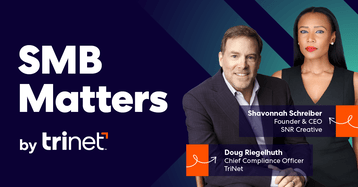
Doug:
Welcome to a new episode of SMB Matters. I'm Doug Riegelhuth, Chief Compliance Officer at TriNet.
Shavonnah:
And I'm Shavonnah Schreiber, Founder and CEO of SNR Creative. I work with organizations on brand strategy and leadership communications, helping leaders translate values into real‑world impact.
Doug:
Today, we're talking about leadership—but not the buzzword kind. We're digging into why traditional leadership models just don't cut it anymore, especially for small and medium‑sized businesses navigating constant change. In light of economic pressure, societal change, regulatory shifts, and fast‑moving technology, SMB leaders are challenged more than ever before.
Shavonnah:
Absolutely. So, good leadership today looks very different than it did even a decade ago. AI, global uncertainty, shifting workforce expectations, and increased focus on corporate governances are all colliding at once. SMB leaders feel that pressure every day—and many are realizing that the old playbook just isn't enough anymore.
Doug:
When you look at where many leadership models came from, it's not surprising they're starting to break down. A lot of what many leaders still rely on today was built during the industrial era—command‑and‑control leadership, rigid hierarchies, and efficiency above all else. Leaders were expected to plan, direct, and control, often with very little emphasis on human connections or impacts.
Shavonnah:
Over time, those ideas began to soften. We saw more people‑centered leadership emerge—recognizing motivation, trust, and collaboration as critical drivers of performance. But many organizations got stuck halfway. Some never moved past outdated, top‑down approaches. Others swung too far in the opposite direction, becoming so informal that accountability and clarity suffered.
Doug:
And neither extreme works anymore. Especially today, employees and customers care deeply about how organizations behave—not just what they produce. Leadership is no longer judged only on results, but on alignment of results and methods to values, and on credibility and decision‑making under pressure.
Shavonnah:
That's where the idea of the "ethics economy" really comes into play. Stakeholders—employees, customers, investors—are paying attention to governance, environmental impact, data privacy and security, and how companies use AI. These issues influence where people choose to work, buy, and invest in ways they simply didn't years ago.
Doug:
Trust has effectively become its own currency. People engage more with businesses they trust and disengage from the ones they don't. That fundamentally changes what leadership means. It's no longer just about performance—it's also about fairness, integrity, corporate responsibility – in short, ethics.
Shavonnah:
And that calls for a new kind of leadership, what we like to call an ethical leadership. To be clear, this goes well beyond compliance. Regulations come and go, but stakeholder expectations don't. Ethical leaders can't afford to treat shifting regulations as permission to lower standards. Stakeholders' standards are the true litmus test.
Doug:
Exactly. Leaders today are navigating regulatory changes, political polarization, and social pressure all at once. The easy trap is thinking that relaxed regulation means relaxed responsibility—but ethical leadership asks a tougher question: just because we can do something, should we?
Shavonnah:
That question applies across the board—how companies treat workers, how they use AI, how they approach diversity, global operations, and environmental impact. Ethical leaders don't avoid these issues. They engage with them thoughtfully and transparently. And to answer the question directly, no, just because we can do something doesn't mean we should.
Doug:
At the core, ethical leadership still comes down to a few essential traits. Transparency—being open about decisions and tradeoffs. Integrity—doing what you say you're going to do, even when it's inconvenient.
Shavonnah:
Empathy is another big one—understanding the perspectives of employees, customers, and partners. And accountability—owning outcomes, especially when things don't go as planned. Empathy and accountability qualities build trust, and trust is what sustains organizations through uncertainty.
Doug:
So how do SMB leaders actually build a leadership model that works in this environment? It starts with recognizing that increasing complexity requires increasing sophistication. Ethical leaders take the time to clearly define their values—and then build governance frameworks, policies, and practices that bring those values to life.
Shavonnah:
Consistency is critical here. Leaders can't afford to whipsaw their organizations back and forth every time political or regulatory winds shift. That kind of instability erodes trust—internally and externally—and makes leadership harder, not easier.
Doug:
Take AI, for example. Even without broad regulation, leaders are expected to think about fairness, transparency, and human oversight. That means testing systems carefully, monitoring outcomes, and ensuring people can question or appeal decisions driven by technology.
Shavonnah:
The same applies to global operations and environmental responsibility. Changes in the regulatory environment might incentivize certain behaviors, but ethical leadership asks bigger questions about long‑term sustainability and responsibility. Just because regulations change doesn't mean stakeholder expectations do. Values—not loopholes—should guide decisions.
Doug:
The big takeaway is that ethical leadership today is about navigating complexity and uncertainty without losing sight of what's most important. In short, it's about driving performance and innovation that is aligned with values and integrity, leading to results that the company and all its stakeholders can readily appreciate. It's also about being able to communicate that clearly and credibly to internal and external audiences.
Shavonnah:
And it's also about recognizing that no leader can do this alone. The era of the lone heroic leader is over. Modern leadership is collective—leaning on experts, empowering teams, and inviting diverse perspectives into decision‑making.
Doug:
Leadership is undeniably harder today than it used to be—but it's also more meaningful.
Shavonnah:
SMB leaders who commit to ethical, values‑driven leadership aren't just managing risk. They're building trust, resilience, and long‑term success.
Doug:
The future belongs to leaders willing to engage with complexity, lead with integrity, and bring others along with them.
Shavonnah:
And that's a future worth building.
Doug or Shavonnah:
Thanks for listening to SMB Matters. If you enjoyed today's episode, a quick rating or review helps others discover the show. Share it with a colleague or someone in your network who might find it useful. SMB Matters by TriNet is dedicated to bringing small and medium‑sized businesses timely, relevant insights to help them thrive.


