The State of Work Podcast with Jasmin Weber (Southern Central)
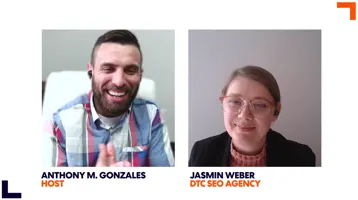
Join us as we explore the rapidly evolving world of search and AI with Jasmin Weber, Client Strategy Owner at DTC SEO Agency, an Austin-based firm helping direct-to-consumer e-commerce brands grow through organic search. Discover insights on SEO in 2026, generative engine optimization (GEO), AI fluency, and how small businesses can show up in ChatGPT, Perplexity, and Gemini — not just Google.
0:00 — Anthony: Welcome. Thank you for joining us today. I'm so appreciative to have you here. So, take a moment, introduce yourself, tell me who you are, what you're working on.
0:17 — Jasmin: Yeah, absolutely. My name is Jasmin Weber. I am a longtime resident of Austin, Texas, and I am lucky enough to work with a small agency that's local. We're called DTC SEO Agency, and we provide SEO services primarily for direct-to-consumer e-commerce websites, as the name would imply.
0:33 — Anthony: I love it. And for perhaps people who aren't familiar with SEO, what does that stand for and what does that mean in 2026?
0:40 — Jasmin: Absolutely. SEO is search engine optimization. Essentially, the goal of SEO is to get you on the first page of Google. Search engine optimization means optimizing a website in order to rank better within organic search. So when you search something in Google, who shows up on that first page? Our goal is to get our clients' websites listed on that first page within search results. What does it mean in 2026? A lot of different things, including what I just mentioned. There's the whole growing sphere of AI and GEO, which is generative engine optimization. That's something else we're working on, which essentially means not only are we trying to get our clients on the first page of Google, we're also trying to get them showing up when people search in AI — showing up within those results, showing up at ChatGPT, Perplexity, Gemini, those kinds of sites.
1:24 — Anthony: Thank you for sharing — that's a lot of context, really important for the non-tech folks. If they can't find you... I have some questions for you about the data and what we've seen for smaller employers — companies your size that tend to offer some very flexible hours, and employees recognize them. But the focus on the companies versus what the employers have to offer versus what the employees feel is a little bit different, and it's a pretty big difference. I was just wondering if you had any thoughts as being an operator and having employees in a small business, where this work-life balance initiative comes from, what kind of culture you have to establish, and how it gets established in a small company. What are your thoughts?
2:08 — Jasmin: Oh, yeah, absolutely. It's a tricky one. My background is specifically in small businesses and startups, so I'm going to speak from that mindset. But I think small business owners — there's such a tendency for that kind of 24/7 work mentality, and sometimes that can bleed over into what the expectations are for employees as well. And as soon as you're blurring the lines about availability and flexibility, it can be really hard to maintain work-life balance, and it can compromise what the work-life balance looks like for employees. So I think a big thing to combat that is having really clear availability and a very clear setup for how an employee utilizes the work-life balance that is offered to them. An example I would throw out there — I think a lot of small businesses fall into the trap of "we offer unlimited PTO," but what does that actually mean for the employee? Are they actually able to make use of that kind of structure? It's really nice on paper, but if it's not something that is actionable, it doesn't help work-life balance. I think a big thing for small businesses is making it clear and easy for an employee to be able to access those perks, those options that are available to them, as opposed to just making it amorphous. The more clear that you can have those work-life balances spelled out, the more clearly that you can make it available to your employees, the more they feel that they can actually access it. It's not just something that is said, but it's something that is actionable.
3:40 — Anthony: I agree. And to what you were sharing — this fallacy of "unlimited." Unlimited isn't a number. It's an undefined variable that we put when we don't have a number to use. And if you use zero of something unlimited, is it really unlimited, or did it have a very discreet and finite limitation based off of utilization? One way for other operators, just as a tip — I have a team of subject matter experts that I get to see, and I get to see a lot of businesses operate. So I get to cherry-pick what one business does really well: "Hey, have you thought about this? This business seems to be pretty happy over there." And if you have unlimited PTO, in order to hedge, you need to make it compulsory where they have to take off seven days.
4:27 — Jasmin: Oh, that's brilliant. I think that's fantastic. Having something like that built in — something very explicit — it probably makes a world of difference, as opposed to someone who feels they're unsure of where things land. The more that you can ensure that people understand what they can do, what they can action, the better.
4:44 — Anthony: Yeah, absolutely. I love the idea of a forced paid time off. It's a passive audit, if you will. Does things still exist when every person takes one week off? And it should, because that's how good companies run. So yes, you can say it's altruistic for your employee benefits. You can say it's both — you don't need to delineate. But resetting, having mental clarity, having these pauses, these breaks — I think the Europeans have mastered that. They literally take like all of August off. I hope that's not stereotypical, but just in the work balance. They have these big winter breaks, these big summer breaks. And if there's one thing American culture could take from Europe beyond their wine, it's definitely the ability to take off long periods of time and enjoy that.
5:29 — Jasmin: No, I couldn't agree more. Okay, so two points there. I think the idea of having checks and balances in place where there is naturally someone who's going to go in and look over what you've been doing is one of the most beneficial things that you can do. When you get siloed, when you're doing everything yourself, is the easiest time for mistakes to kind of pile up and compound. And I was born in Germany, so I could not agree more as far as the European work-life balance. It boggles the mind every time I go back to visit just how much it works for them.
6:00 — Anthony: So, back to the TriNet State of Work Report for 2025. AI adoption — in Texas, employers report that they're using AI about 72% of the time. Employees are only like four to six, and about a quarter of folks are never using AI, self-admitted. So, you use AI every day. Out of curiosity, like production tools — what's an honest difference between AI actually changing your work, and you hear employers just assume people are using AI for their employees, but it's like, well, are they?
6:35 — Jasmin: Okay, yeah, absolutely. Well, I do use AI every single day. It's a really beneficial productivity tool for me. What I have run into in the past, and the biggest misconception I've seen between employers and employees, is an employer saying, "You have access to AI now, you can 5x, now you can 10x your output. We can just exponentially increase the amount of work that we're able to do." And I think that's kind of a slippery slope and a little bit of a dangerous way to look at things. Because AI can absolutely help increase the amount of work that you do, but I don't know that the focus of how you use AI should be how much work can I do. I think the focus should be how much can I improve the work that I am doing. If an employer has the mindset of "now that we have AI, we can increase the amount of work that we do by 10x or whatever number," an employee is going to feel pressured to produce as much work as possible, as opposed to producing as high-quality work as possible. And for myself, and I think for DTC as a whole, quality is non-negotiable. So if you're using AI as far as quantity is concerned as opposed to quality, I think that can be a misconception between employers and employees. For myself, the way that AI plays a role in the work that I do is in many different facets. Is there a way that I can shave 20 minutes off of a task? Is something going to be terribly labor-intensive and manual, but I can put it into AI and get it done in 3 minutes? Amazing. Have I just done a bunch of research and I want someone to double-check my work? AI is a great way to double-check the work that you've done — see if you're missing some information. And of course, you have to be mindful of the fact that hallucinations exist. Just a quick side note, we've been using Claude quite a bit recently because we noticed there are fewer hallucinations with that tool. So I just throw that out there — that's my favorite go-to for double-checking the research I've done. But really, diving deep into things: what have I missed? What could I potentially expand my research on? And then creating tables, creating presentations — the more that I can expedite the work that I need to do, the more I can improve my efficiency, the more time that I have to spend on those really deep-dive research, highly technical tasks.
8:39 — Anthony: So that all being said, people are using AI differently, and you seem to be using it in a certain way. Are your employees using it in the same capacity you are? Because this is what our research is showing — the employers are saying, "Yeah, I'm using it, I get productivity," but distributing that efficiency down to all the folks seems to be where there's a mismatch.
9:00 — Jasmin: Okay, absolutely. I think it really revolves around the ability to have SOPs in place. We have a lot of internal in-house prompts that we've created for very specific tasks. So you need to do X, you use the prompt for X. You need to do Y, you use the prompt for Y. Spelling it out like that, making it very easy for anybody to jump into the role and to find the same kind of results that you're finding — it kind of has to be that way. If you tell people, "I've utilized AI for X, Y, and Z," but you don't tell them how to do so, you're never going to get that kind of clear line of communication. It's a little bit of a game of telephone. And AI is also so specific in the way that you communicate with it. The verbiage that you use when you ask questions to AI really influences the response that you get. So I think that kind of specificity and having it be a cultural standard that you use the same prompts for the same tasks can be a huge benefit.
9:55 — Anthony: AI is a fluency. It's a language. It's a craft. And I think we are very nascent in our ability to communicate. But if you're not talking at all, you're going to be monolinguistic. That's gonna be a big problem, because AI is not going to take your job. The human who learns how to speak AI is going to take your job, because they can have the robots work for them.
10:22 — Jasmin: 100%. Oh man. Yeah, it's such a fascinating thing. I think that GEO and the way that generative engine optimization is growing has so much to do with that. How do we communicate with AI? That's essentially the question of GEO. Because the better that you can communicate with AI, the more likely you are to have your content show up in its results. So a huge part of GEO, and a huge part of what we're doing, is trying to structure the content that we create to be as easy to read for LLM models, and as full of data-rich, experiential content as possible. Like you said, we're so nascent. We're so new to this. It's a burgeoning thing right now, and it's something we're learning a lot about as an agency in real time. A big part of what we're working on as far as AI is concerned in GEO is how to communicate with those models as efficiently as possible, in the way that they want to be spoken to.
11:21 — Anthony: And so what can a small business owner in 2026 strategically, philosophically do different about brand safety, brand narrative, having a voice on the internet? Is social media still the place to be spending your time? Is content and influence still the day of the age? Or is there a new flavor in town? Just what are your general thoughts? If I'm a small business listening to this long interview and I'm tuning in, how can we learn from you guys?
11:51 — Jasmin: Oh yeah, it's a fantastic question, and it's changing all the time — our understanding of what is most important and most relevant for these answers. I would strongly suggest to any small business owner: build out your authority on your website. The more that you can show that you are an authority in your space, the more likely that an LLM model is to trust you as a source. You were talking about these websites that have very high domain ratings. It's hard to beat them. It's really challenging to beat a high domain rating website, especially one like Reddit that has so much user knowledge inside of it. So what can you do to be somewhat competitive? You can include firsthand testimonials on your website. You can include as many markers as you possibly can about your credibility, your qualifications, certifications. These things are more important than ever. They've always been important for SEO, but in terms of LLM and showing up in AI search, it is really more important than ever. That's the number one thing that we have seen make a difference as far as how to be competitive against a website that has twice the domain rating as you. Prove that you're a better authority than they are. Prove that you have more knowledge, insider knowledge, than they do. And if you can show that on your website, you have a chance of showing up in those searches.
Let's say you work in HVAC. Show the certifications that you have on your website. Make an About Us page that shows a picture of the person who's doing the installations. Talk about their education. Talk about their experience. Are they specifically knowledgeable about the area that they're working in and the location — the specific issues that might be impacting the location they're working in? Show that. How long have they been in business? Can you create blog articles that show in-depth knowledge about the types of tools that you're using, the products that you're selling? Are you doing research on the up-and-coming new technology that's coming out in your field? If you can show this kind of information on your website very clearly, that's going to be really beneficial. Other things that you could potentially do — and this is off-site — but always linking back to your site as much as possible: creating listings in directories, creating listings on high-authority websites that point to you, that's also going to be hugely beneficial. But really building up the content on the site to show authority in that space is one of the largest things that we've found that has impacted our clients.
14:04 — Anthony: That was some really solid advice. They're going to get a bunch of clips out of that one. So, great job. Philosophically, when we seek improvement, we often have this fallacy that we should be doing more. However, sometimes the best way to improve is actually doing less. So I want to ask you the same question again: what should people never do, or not do at all, when it comes to the same strategy?
14:38 — Jasmin: If there's one thing that's going to make a difference, honestly — building poor-quality backlinks. That has been such a big part of SEO for such a long time: the number of backlinks is the most important, as opposed to the quality of the backlinks. You can shoot yourself in the foot so quickly by having — it looks so nice, "Oh, 150 links on this page, 150 backlinks to that page." If they're garbage, Google knows they're garbage. And even more than that, the LLM is going to recognize that your site is doing something manipulative. Easiest way to tank your rankings, easiest way to ensure that you're never seen as a trustworthy site. If your site is not viewed as trustworthy, the likelihood that you will show up in an LLM search is almost zero. Those LLM models are very specific on using websites that are trustworthy. The information they want to share is viable, legitimate, authoritative. If you have a significant number of spammy, fishy-looking backlinks on your website, easiest way to tank things. So I would say, while links are important, the quality of the links you're building is potentially more important than ever before. If you're just throwing a bunch of money into sheer numbers of backlinks, you are probably doing yourself a great disservice.
15:51 — Anthony: But yeah, we're focusing on small businesses. They got 17 employees. So this is your world. You do have some authority. I'm not macroeconomically speaking — just like a Texas small business owner sitting next to you, and they're asking you, "Hey, should I go spend 10 grand on my HVAC business?"
16:07 — Jasmin: Consumers are savvy. A consumer searching on Google sees the sponsored results. A lot of people are going to scroll past them to an organic result because they understand that someone has paid to exist there. Not everybody — there are plenty of consumers that will click through to a paid advertisement, and that's why they still exist. But I would just be very cautious of throwing a bunch of budget towards something that a lot of people are already wary of. On top of that, to be clear, paid and organic go hand in hand, and the results that you see in one are likely going to impact the other. So if you are already doing paid advertisements and you're seeing success there, I certainly wouldn't tell you to stop doing so. But if you're trying to find a new way to gain revenue, if you're trying to open up new resources, in today's day and age, you might not get the click-through rate that you're expecting, because a lot of consumers have become quite savvy about that.
17:01 — Anthony: Can you comment on how people can protect and have some brand safety? I've heard this term "domain warming" or "inbox warming," in which you want to kind of have these little touch points and start conversation before you start too much, because you get banned. Do you have any thoughts of how a business owner who wants to use bots, but again, give them some guard rails so they don't get blacklisted on the internet?
17:21 — Jasmin: Yeah, absolutely. It is a big concern. If someone is potentially going to do outreach via email, I would be very cautious about using your domain name. As soon as you are flagged as spam, your domain can be significantly impacted. What we have done is we typically use a separate domain in order to do email outreach. We do outreach link building, and in order to do that successfully, we have to ensure that we protect our domain. So a separate URL, a separate domain that you're able to use for that purpose, is really ideal. Obviously, your website's domain has a lot of authority to it, so it's really nice to send outbound emails from that domain, but the risk is far too high. I would highly recommend using a separate domain in order to do so. If you're able to purchase a relevant, related domain, that would be the ideal.
18:17 — Anthony: Let's discuss bilingual SEO. Is it worth the time, given bots? Like, "Well, I have mine in Spanish and Norwegian," and to go in and just — whatever, why not? Here's a bunch of things. Or is that a damaging thing? Are you cannibalizing your own SEO?
18:32 — Jasmin: Oh gosh. Great question. If you are serving those countries — let's say you're an e-commerce website and you ship internationally — there is absolutely a benefit to having those specific separate language sites that you can create. We typically work within Shopify.
18:57 — Anthony: Like, is it worth having — again, you're going to go to Claude, say "translate my website into German." Is it worth having another instance with the .de and exact rendition of .de? So if someone's on google.de —
19:03 — Jasmin: Yeah. So there are specific ways to set it up that it should not cause internal competition. We have had clients in the past that have come to us with things that were not set up properly, and it did create internal competition where they had websites that were ranking for English terms that should have been ranking for German terms, or vice versa. It's a matter of technical setup. Ensure that when you're in development, you're setting things up technically properly. There is a way to do so that will avoid that kind of internal competition. We typically work with Shopify sites, and it makes it quite easy to set up those kinds of multinational sites without cross-competition. As far as content is concerned, you certainly don't want duplicate content on your website. That can be an issue. However, if things are set up properly, if things are translated properly, you shouldn't run into an issue with having multiple languages on your site. I'll be honest, I couldn't break down for you on this call the exact technical best way to set it up language by language, but there is a way to do so. I would say speak with development teams and ensure that you're setting things up properly. If it's done properly, it can be a huge benefit to SEO. If it is done improperly, it can absolutely cause competition. Something to be mindful of, but there is a real potential benefit there.
20:24 — Anthony: Thank you. I appreciate that. One of the things that I have yet to see be integrated as well as I think it has the potential to be are voice agents and voice user experience on websites. And it is quite easy these days, just as it is to spin up a bot, to spin up a voice bot, and to have people land on a website and that actually be where they're getting a lot of their information from. I don't need to go read a blog. I'm just going to talk to the voice agent on your bot and ask him about the blog, and he's just going to tell me about the blog. Have voice agents crossed over to SEO? Do you have any thoughts or comments, or have you used voice agents to encourage that for your clients? Like, "Hey, you don't even call me, why have a phone number, just have a live ElevenLabs voice agent, they can talk, and then you'll get an email, the transcript, it'll go right to your CRM." To me, that's like the Neo 2026 Y Combinator startup flavor of the day. In 2014 it was 3D printing; now the tech boom is like, "Oh, voice this, voice that." How does this cross over into your world? If I'm a 20-person team in Austin, do I care about a voice agent for my sandwich shop?
21:35 — Jasmin: Fantastic question. Honestly, from an SEO perspective, my concern is that you would spend so much time focusing on the voice assistant that you might neglect content. From an SEO perspective, we certainly wouldn't want to neglect the content on the website. So I'm almost concerned about the opposite there. From a UX/UI standpoint, if the bot works right — that's the big caveat. Does it function the way that people need it to? In today's day and age, there are a lot of voice models that are really successful, and there are some that are less. So I think if you're implementing something that really enhances the user experience, go for it. UX/UI is huge at the end of the day, and as far as conversions are concerned, it can be a big thing. Ensure you're not neglecting your blog content. Ensure you're continuing to build that out. The more that you can add that kind of content to your website, the better. But if it functions the way that consumers need it to, I would go for it. I think that's a fantastic idea.
This is a little bit off topic, but I feel like it's relevant enough that I'm going to bring it up now. Are you familiar with Whisper AI? You record your voice, and it creates notes for you based off of your voice memos. It's one of the most accurate tools that I have ever used as far as voice memos are concerned, and its ability to summarize your thoughts for you is pretty phenomenal. So that's something we're using quite a lot nowadays. If I'm in a meeting — actually, you know what, before this call, I was sitting there and talking out my thoughts and having it summarize points for me. So that's a great use case — for this interview right here, I used that voice app. I love it.
23:16 — Anthony: That's great. Super helpful. As I mentioned, AI is a language, and if you are not seeking to obtain fluency, you are behind the curve. There were a lot of terms today, a lot of deep technical jargon. I would encourage you to reach out to our guest if you have more questions about her services. But I just want to express my appreciation and thank you for joining us today. I have a closing question for us here. Professionally, I think you're in a good place — it's the right audience, it's the right moment. A lot of small businesses out here need to do things. What's one thing that you might want to share as a takeaway — if we were skating to where the puck is going, and less about like, "Hey, here's what you should have done," but like, great, it's now, here's what you have, the ability, the agency, whatever your SMART goals are. Give us some wisdom.
24:08 — Jasmin: Yeah, absolutely. I would say to any small business owner that's perhaps hesitant about using AI or reluctant to start utilizing it more than they are right now — fostering your employees to educate themselves and to do continued education and continued research with AI, with language learning models. The more that you can do that, the better. It's a constantly growing field. It's something that is growing very quickly. And the projections show that more and more people are going to be utilizing AI in the coming years. What that means is even if you haven't started now, you can start now. You can start learning about it. You can start educating yourself. You can start implementing new initiatives. And I would also say that utilizing AI in your business doesn't have to mean relying on AI. I think some employers and some small businesses are concerned that once the floodgates open, there's no turning back. You don't have to use AI for everything. It's there as a tool for you to utilize when it's best for you and when it's most beneficial for you. The sooner that you can start that kind of research and edification, the better, because it is growing quickly, and it is something that is going to impact consumers more and more.
As far as real tangible steps to take — start watching some videos from AI experts. We watch a lot of videos from people who are experts in the field of AI. It could be individuals, it could be companies that are doing a lot of research around this. But the more that you can watch, the more that you can take in knowledge that's already out there and start applying it to your own business, the better. You don't have to do everything all at once. A first step towards utilizing AI is really better than not doing so at all.
26:06 — Anthony: Well, maybe I could share an anecdote with us. Nvidia's CEO recently made a bold claim, an inflammatory claim, that if your engineers aren't spending their base salary in tokens, they're not using AI enough. So back to where we started this conversation about compulsory PTO — it could be a habit where you require your employees to use a certain amount of tokens every month, because they should in their day job. They should be using AI. You get these — it'll clearly bubble up who isn't adopting, who isn't being efficient. And maybe that's a parameter you need to have in place to understand who needs to have performance reviews about AI adoption. Because some people do not like change, and they will not use new stuff, no matter how much you ask them to, no matter how much efficiency gain. You have to ask yourself as an operator: is that the culture and environment you want to support, or do you need to think about how you can have other individuals who have different philosophies on new technology and utilization?
27:04 — Jasmin: Yeah, absolutely. I think enforcing something like that is a brilliant idea. What we do at DTC is a little bit different, but perhaps along the same mentality. We have enforced hours that are spent specifically toward AI research. So I have three hours blocked in my schedule every single week where I'm doing in-depth research and finding what I can, and then I bring it and share it to the team in a group setting. Something like that could be a fantastic way to ensure — as long as you're enforcing the sharing part. I think that's kind of key. People have to bring what they found to the meeting and share it with other people to ensure that they're actually doing so. That's something else I would recommend — that kind of shared learning session where you're enforcing learning and then sharing that learning. It means that you won't fall behind, but you're instead growing at the same speed as other companies, as your other employees, etc.


