SMB Matters with Daniel Harris: Recognizing and Celebrating Black-Owned Businesses
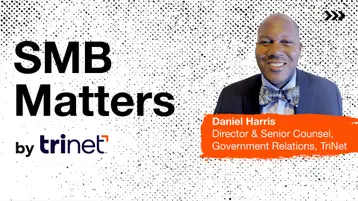
Welcome to SMB Matters. I am Daniel Harris, Director & Senior Counsel of Government relations at TriNet, where I’m an expert in regulatory affairs. This podcast series takes a close look at the latest news and trends on a variety of topics related to running a successful small and medium sized business.
August is National Black Business Month. Created in 2004, it highlights the distinct needs and value of Black-owned businesses in America. Like much of Black history, the history of Black-owned business in this country is a study in perseverance. Many have heard of Oklahoma’s “Black Wall Street,” which was the scene of the grisly Tulsa Race Riot in the early 1900s However, the first Black-owned business – the African Insurance Company – was founded nearly ten years prior in Philadelphia. Shortly thereafter, Thomas Jennings became the first Black person to be granted a patent for his “dry-sourcing” process, predating what we now know today as dry cleaning Both preceded Johnson Products, which is notable – among other things – for being the first Black-owned company to be listed on the New York Stock Exchange.
There are obviously many other Black-owned businesses in many, different industries. According to the US Census Bureau’s Annual Business Survey, which was conducted in 2020 and represents the most recent available data, there were an estimated 140,918 US companies with majority Black ownership. That number represented a nearly 15% increase from 2017 Those companies brought in an estimated $141 billion in gross revenue, an 11% increase over the same period. The greatest number and share of Black-owned businesses are in the healthcare and social assistance (i.e., psychology, rehabilitation, and social work fields) sector. In 2020, 28% of the total number of Black-owned businesses were in this sector. What was second? Professional, scientific, and technical services accounted for 14% of the total number of Black-owned businesses in 2020. Construction, administrative and support, and waste management rounded out the other common sectors for Black businesses.
Though the impact on most private employers may be minimal, the recent US Supreme Court decision to prohibit the use of affirmative action programs at Harvard and the University of North Carolina – where the Court decided that neither school could give an applicant for admission favored treatment based on the applicant’s race – could have an outsized impact on the recent rise in Black-owned businesses and the communities they serve. Many believe the Supreme Court decision will result in decreased numbers of Black students enrolled in our nation’s universities. . And while this may result in fewer Black employee professionals, negatively impact diversity at universities and college campus’, and have a chilling effect on Diversity, Equity, and Inclusion programs in the private sector, this could mean fewer Black-owned businesses as according to the Pew Research Center, most Black business owners (60%) had an undergraduate degree or higher. And even with the recent rise in the number of Black-owned businesses, such businesses only account for 3% of all US employers. So, any reduction in the number of Black businesses would be a substantial loss.
It's no surprise that most Black-owned businesses are in urban areas with Florida, California, and New York leading the way. Indeed, these also happen to be three of the four most populous states in the union. However, it is notable that Black businesses make up the greatest percentage of businesses in DC, Georgia, and Maryland, or areas with a significant Black population. In these communities, Black-owned businesses employed 1.3 million people. A decrease in Black-owned business could also lead to a decrease in employment in the communities they serve and could be potentially catastrophic for those communities.
For its part, TriNet is helping businesses – Black-owned and others – including increasing access to and awareness of grants, programs, and other resources available to Historically Underutilized Businesses through a portal on its website. We encourage entrepreneurs to explore these resources TriNet has pulled together, connect with relevant programs, and take advantage of the support available to propel their businesses forward. Together, we can create a more inclusive and thriving entrepreneurial landscape for Black-owned businesses and others.
Thanks for listening to SMB Matters. If you enjoyed this show, please leave a review on Apple Podcasts, Spotify, or wherever you listen to your podcasts. And please share it with a colleague or make sure to subscribe to our newsletter at TriNet dot com slash insights.
Also, we’d love to hear from you so please feel free to drop us a line at smbmatters @t rinet dot com. SMB Matters by TriNet is committed to providing small and medium sized businesses with timely and relevant insights.


