Ethics Economy: Why Ethics and Culture are Key to Driving Business Success
Intro:
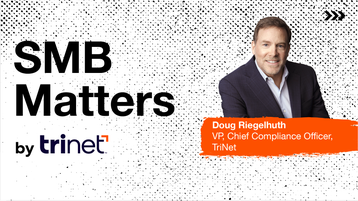
Welcome to SMB Matters- I am Doug Riegelhuth, Vice President and Chief Compliance Officer at TriNet. This podcast series takes a close look at the latest news and trends on a variety of topics related to running a successful small and medium sized business.
Today, I’ll be talking about the importance of ethics and compliance as drivers of business activity and outcomes like never before. So important are these drivers that many like to say we are operating in the ‘ethics economy.’ The data backs this up.
On average, companies with highly advanced ethics and compliance cultures have outperformed in the stock market when compared with similarly situated large companies lacking such cultures. This is according to data collected by Ethisphere, a leading ethics and compliance consulting firm.
Why is this the case?
For starters, investors have been ramping up investments based on company rankings or scores relating to ESG – which stands for Environmental, Social, and Governance. In other words, companies are reporting on their ethics and compliance efforts in so-called ESG reports (also/known/as corporate sustainability reports), and investors are making decisions about where to invest their money based on this ethics and compliance reporting. According to PwC, asset managers globally are expected to increase their ESG-related assets under management to $33.9tn by 2026, up from $18.4tn in 2021.
Another potential reason for the most ethical companies outperforming others is that top-tier diversity typically comes about as a result of top-tier ethics. What does this have to do with the economy and business outcomes, you might be wondering. Well, the management consultancy McKinsey has found that highly diverse organizations (specifically those in the top-quartile for diversity) tend to outperform less diverse organizations by a wide margin.
And this focus on the workforce gets to the heart of another factor. Data shows that, globally, the majority of employees decide where to work based on alignment of their values and beliefs with company values. So, ethics is a big deal when it comes to attracting and retaining talent. And this same trend is happening with customers. The data shows that more than 50% of consumers of goods and services are basing purchasing decisions on alignment of values and beliefs.
We’ve reached the point where the long-standing principle that corporations are responsible primarily to their shareholders is being challenged – by the notion that corporations are responsible to a range of stakeholders. Simply put, businesses are increasingly accountable not only to investors but also employees, customers, and, by extension, their communities.
Of course, regulators are pushing, too. The Department of Justice, when it looks at how to respond to instances of corporate wrongdoing, is now placing more emphasis than ever on a company’s culture of ethics and compliance. And, for publicly traded companies, the Securities Exchange Commission is looking to require climate change-related disclosures and reporting, and it already rolled out new requirements this year related to executive compensation.
So, what are SMBs to do in light of all this? The answer to that question will depend on where they are in their journey, but here are some ideas for SMBs that are in the early stages of ethics and compliance program building:
- Make sure you have a mission, vision, and values that resonate in the ethics economy, and that are frequently communicated and reinforced.
- Get up to speed on ESG – and ensure any reporting you do is honest and accurate.
- Make DE&I efforts into a program rather than an ad hoc approach.
- Make your Code of Business Conduct and Ethics easy to read and visually inviting. (Lots of examples can be found online because companies often post their Code online for all to see. TriNet’s Code is online, in case you’re interested.)
- Ensure regular training on the Code and make it user-friendly.
- Make sure policies and standards (and associated training) are clear, concise, and inviting, too.
- Take data security and privacy concerns very seriously, as these are (by some measures) the top compliance risks at this time.
- Encourage employees to speak up about ethics and compliance concerns without fear of retaliation.
- Take such concerns seriously by ensuring that they are properly investigated, and that appropriate corrective action is taken, when warranted.
- Make it easy for employees to understand when and how to disclose actual and apparent conflicts of interest, high value business gifts and entertainment, and other issues so that they can be properly vetted and addressed.
- Take steps to make sure that your suppliers and vendors are focused on ethics and compliance.
- Finally, make the case for ethics and compliance in much the same way as I’ve made it here. Communication and conduct from the top of the organization – and from middle management – that reinforces the importance of doing the right thing – not only because it’s right but also because it’s good for the business – will go a long way toward creating the culture of ethics and compliance that is so important for all businesses trying to succeed in the ethics economy.
CLOSE:
Thanks for listening to SMB Matters. If you enjoyed this show, please leave a review on Apple Podcasts, Spotify, or wherever you listen to your podcasts. And please share it with a colleague or make sure to subscribe to our newsletter at TriNet dot com slash insights. Also, we’d love to hear from you, so please feel free to drop us a line at smbmatters @ trinet dot com. SMB Matters by TriNet is committed to providing small and medium sized businesses with timely and relevant insights.


