The Corporate Transparency Act: What You Need to Know
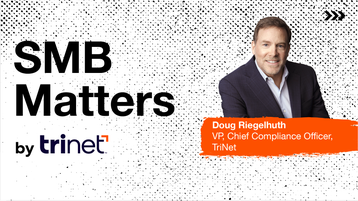
Welcome to SMB Matters. I am Doug Riegelhuth, Vice President and Chief Compliance Officer at TriNet. This podcast series takes a close look at the latest news and trends on a variety of topics related to running a successful small and medium sized business.
Today, I’ll be talking about the Corporate Transparency Act (or CTA) – a federal law that focuses on small businesses. Maybe you’ve heard about it already, which would not be surprising because it went into effect on January 1, 2024.
The CTA imposes new federal reporting requirements on most small businesses operating in the United States. The purpose of the CTA is to create a national database of companies that identifies the human beings behind the companies. The goal is to use the information to combat money-laundering, terrorism, tax evasion, trafficking, and other crimes.
Under the CTA, small businesses are required to file a beneficial ownership information report (or BOI report) with the United States Treasury’s Financial Crimes Enforcement Net (or FinCEN). Small businesses need to be well-versed in this law because:
- Information gathering for the required reporting may be onerous and difficult in some instances,
- Deadlines to report and update are short, and
- Penalties for non-compliance can be significant.
So, Which Companies Must Report
Any small business entity that is created by filing paperwork with a Secretary of State is a potential “reporting company.” This includes limited liability companies (LLCs), corporations (both C and S corporations), limited partnerships (LPs), and other closely held entities. It does not include general partnerships or sole proprietorships (but does include single-owner LLCs). There are a few exceptions, including but not limited to certain charitable or not-for-profit entities, so-called “large companies” (defined as those with 20 or more employees and $5 million or more in revenue, among other things), and entities already subject to regulation (e.g., banks and other financial services industry companies). Companies with shares that are publicly traded are not covered by the law.
There is also an exception due to a court order arising from a lawsuit challenging the constitutionality of the CTA. On March 1, 2024, in the case of National Small Business United v. Yellen, a federal district court in the Northern District of Alabama, entered a final declaratory judgment, concluding that the Corporate Transparency Act exceeds the Constitution’s limits on Congress’s power and enjoining the Department of the Treasury and FinCEN from enforcing the Corporate Transparency Act against the plaintiffs. The Justice Department, on behalf of the Department of the Treasury, is appealing that order. While the appeal plays out, the government is not currently enforcing the Corporate Transparency Act against the plaintiffs in that lawsuit: including members of the National Small Business Association.
When Must Reports Be Filed
The reporting deadline for BOI reports depends on when the entity was/is formed.
- For entities already in existence prior to January 1, 2024, the initial report must be filed by January 1, 2025.
- For entities formed on or after January 1, 2024 and before January 1, 2025, the initial report must be filed within 90 days after the formation of the entity. (So, if you created a “reporting entity” in 2024, the report for that entity could be due already or very soon.)
- For entities formed on or after January 1, 2025, the initial report must be filed within 30 days after the formation of the entity.
What Information Must Be Included in the Initial BOI Report
The report must include certain information about the company and any individual who is a “beneficial owner” of the company. A “beneficial owner” is anyone who has substantial control over the company or who owns, either directly or indirectly, a 25% interest in the company. The CTA’s definition of the “beneficial owner” term is broad and complicated, and may apply to individuals you would not otherwise consider to have “control” or be an “owner” of the company.
The information companies must report includes:
- For the company: The company’s legal name and trade names, street address (no P.O. boxes or lawyer’s or advisor’s offices), state of formation, tax identification number, and an identifying document from the issuing jurisdiction (e.g., certificate of information).
- For each beneficial owner: Full legal name, date of birth, home address, and a photocopy of a U.S. passport or state driver’s license.
What about a Duty to Update Reports
Reporting once is not necessarily enough. Under this law, there is a duty to update the report when there is a change to any information about the company or beneficial owners. So, the duty to update the report could be triggered by:
- Ownership changes to the company due to the death of a beneficial owner or a sale of interests in the company;
- Changes to directors or officers; or
- A beneficial owner’s change of address or name (e.g., due to marriage).
Keep in mind, that if a trust is an owner of the company, changes to trust beneficiaries may require updated reporting as well.
Any change must be reported within 30 days of the occurrence of the change.
What about Penalties
There are stiff civil and criminal penalties for failing to file a required report. Civil penalties alone could be more than $500 per day of violation, and criminal penalties could include imprisonment for up to two years and a fine of up to $10,000.
Where to Get More Information
FinCEN has created a BOI page on its website to assist business owners with the new reporting requirements. On that page you will find links to a Small Entity Compliance Guide and FAQs, among other helpful tools.
Thanks for listening to SMB Matters. If you enjoyed this show, please leave a review on Apple Podcasts, Spotify, or wherever you listen to your podcasts. And please share it with a colleague or make sure to subscribe to our newsletter at TriNet.com/insights. Also, we’d love to hear from you, so please feel free to drop us a line at smbmatters@trinet.com. SMB Matters by TriNet is committed to providing small and medium sized businesses with timely and relevant insights.


