Stop-Start-Continue: Key Considerations for Your Business
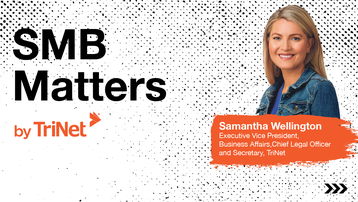
Samantha Wellington:
Welcome to SMB Matters.
I'm Samantha Wellington and I am super excited to bring you the premier episode of this new podcast from TriNet where we’ll be taking a close look at the latest news and trends on a variety of topics related to running a successful small or medium-size business.
Today we’re going to be talking about the impact that macro-economic change can have on the engagement of your employees and how a simple retrospective exercise that you’ve likely undertaken in the context of performance management can be used to reset your business and maximize employee engagement.
I do think that people—human beings or our employees—are exhausted from the last three years. So this is all about perspective—thinking about how the actions of your organization makes sense to your employees. Are you asking for work that employees don’t understand in the context of the future of your company? Does the work you’re doing make sense in the context of your company’s mission, vision and values.
To work this out: start, stop, continue. You all know the exercise. Take stock of what you need to start doing, stop doing and continue doing, but do it in the context of your entire organization. So to do it effectively, you’ll do a retrospective move and you will reassess how you’re currently deploying resources.
A reassessment of whether your current focus and strategy is going to get you where you want to be for your customers in the future and a reassessment of the expectations that you have of all of your stakeholders’ including your employees. And that’s the key component. The outcome of the reassessment is not going to matter if your employees are not on board with your reassessment of what should start, stop and continue.
Something I do think is super interesting about it being time for companies to engage in this exercise is that this has been happening on the employee side of the coin for several years now. There was a time when all the news could talk about was the great resignation or quiet quitting. This was about employees reassessing their lives. For some, it was about starting to focus more of their time on themselves and for others about stopping work that didn’t bring them joy. They “Marie Kondo” their work lives, but regardless, your employees have already done it. Once your organization does it, ideally with the buy-in engagement of your employees, you’ll have taken a step to reigniting trust with your employees.
So to do it, commit to spending no longer than 30 minutes at a high level. Remind yourself of your mission, vision and focus on what’s missing, what’s broken and what’s working in your business. Is your business’s purpose, your mission, vision and values the same as it was three years ago? Mission, vision and values reflect the direction and purpose of your organization. And the world has changed. So, has your direction and purpose changed? Or should it change? If the mission, vision and values really should remain the same, are you not doing something that really speaks to your organizational culture and purpose? And if so, start doing it. Do you think your organization’s North Star has changed such that your mission, vision and values need to be updated?
If it has, that’s totally okay. If your work and purpose has shifted so much when the world changed so much that your mission and vision should align change to align to the work, making that change will instill trust in your employees by ensuring you’re validating a shared value system that matches the work you’re asking them to do every day.
Once you’ve reassessed your mission, vision and values, you can focus on what you need to stop doing. Any work that is not aligned with the mission, vision, values, disconnects you from your employees and erodes trust. In economic times like the ones we’re in now, we’re hearing a lot about doing more with less. That is not smart—not for the employer and certainly not for the employee.
Rather than asking employees to do more with less, reprioritize the work. Stop doing things. Allocate people and resources to what moves you to your North Star and ensures you have the best opportunity to serve the purpose that you say you want to serve for your customers. Asking employees to do more with less is a really good way to have them feel that management is completely disconnected from the day to day.
Instead, ask them to do more of the work that is impactful and to stop the work that is disconnected. Then you’re going to continue doing the work that serves your customer base. Your business has succeeded for a reason. Don’t lose sight of what work got you to where your company is today. And focus on what your company should be doing to serve your customers tomorrow.
This is truly a time of great reassessment for all businesses’ employees have already conducted their retrospective. It is critical that your business does it as well.
Thank you for listening to SMB Matters. If you enjoyed this show, please leave a review on Apple Podcasts, Spotify or wherever you listen to your podcasts. Please share it with a colleague or make sure to subscribe to our newsletter at TriNet.com/Insights.
We’d also love to hear from you. So please feel free to drop us a line at SMB Matters at TriNet.com. Share your experiences with us and stories of how you’ve implemented start, stop, continue or any insights that you might have learned by reassessing the current stage you find yourself in.
I'm Samantha Wellington and I look forward to continuing this conversation.
Legal Disclaimer: This podcast is for educational purposes only. With decades of experience supporting small and medium-size businesses, TriNet has unique insight into HR best practices for businesses. TriNet does not provide legal, tax or accounting advice. The materials in this podcast and the options and opinions expressed herein may not apply to your company or scenario, so you should consult with your own advisors on how best to proceed. Reproduction in part or in whole is not permitted without express written authorization from TriNet.


