Why Employee Engagement Is Good for Business
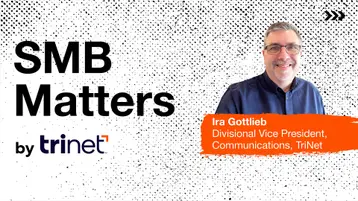
Welcome to the latest episode of SMB Matters. I’m Ira Gottlieb, divisional vice president of corporate communications for TriNet. This podcast series examines the latest news and trends on a variety of topics related to running a successful small and medium-size business.
Today, I’ll be sharing some tips on how to communicate with your employees and ensure they’re engaged with your mission and vision, and why it matters.
It’s safe to say employees want to be engaged with your business – at least initially. Most people join a company with good intentions to help leadership achieve their mission and work towards their vision for the future. However, somewhere along the way, research tells us that many employees – nearly 7 out of every 10 – become lesscommitted to their company’s success.
A recent study by the management consulting firm Gartner, supports this assertion. Their June 2023 survey of nearly 3,500 employees around the world shows almost 70 percent don’t feel a meaningful connection to their job. And the results are consistent across gender, age and geography.
To put these numbers in perspective, imagine if your favorite soccer team had those same scores. Four of the 11 players on the pitch would know which goal is theirs, and just three of 11 would care.
Fortunately, there are tried and true ways to beat the averages and engage more of your employees.
Here are some tips you can use for your business.
Tip number one: Clear and consistent communication. Most – if not all – employees want to be engaged, want to learn about your mission and vision, and want to be part of your success. As a business owner and a leader, you play an outsized role in helping drive employee engagement. Your employees are looking to you for big picture messages about where the company is headed and how it plans to get there.
That’s why it’s important to communicate as clearly as possible your definition of success and your expectations for how employees can contribute to that success. Try to be specific about company goals and the definition of success for the company and the employees.
Tip number two: Less is more. At least as it relates to how you talk with your employees. We are all overwhelmed with information in our personal and professional lives. People spend an average of just 26 seconds reading an article or email. They don’t read, they skim. And people are also distracted – they check their phones an average of 250 times a day or once every 2 minutes.
Don’t let this stop you from sharing information with employees. Remember, they want to hear what you have to say. So, try to be as direct as you can in your messaging. Less formal, and more casual in your tone. Avoid “corporate-speak” whenever possible. Include a clear and easy-to-understand call to action or bottom-line takeaway in your message.
Tip number three: Get closer to your employees. Communicating to your employees is good. Communicating with them – having a dialogue – is better. There are many ways to foster a dialogue. From encouraging comments or questions, to holding a virtual or in-person roundtable session with a small group of employees, to regular All Hands meetings where you solicit questions and feedback from the entire organization.
Understanding how your employees feel about your message, about your mission and vision – is critical to building engagement.
Tip number four: Stay positive. Early in my career, I learned a valuable lesson about communications and engagement. A mentor explained to me that the role of communications is not only explaining what’s happening, but also about providing inspiration. The real challenge – and responsibility – he told me, is to win both hearts and minds with your message. Everyone wants to be proud of the role they play, and the product or service the company provides.
That’s why it’s helpful to tell positive stories. Highlight your company’s successes. Spotlight employees who go above and beyond. Share how your customers are benefitting from what you do for them. You’ll find a bit of inspiration can go a long way.
Okay, final tip: Get your employees to ask “The Golden Question.” Earlier, we talked about how most employees start out wanting to be engaged with your business, and how that can change over time. Well, here’s how employees tend to view engagement. The first thing they want is to understand their job responsibilities. Then they want feedback on how they’re doing.
Once they know that, they are ready to lift their heads up and look at the world around them, and they ask: where are we headed? That’s where you, as a leader, play a key role. Only you can answer that for them.
Here’s the really cool part. Once an employee gets those foundational questions answered – What is my job? How am I doing? Where are we headed? – they will almost always ask the next logical question: How can I help?
And that one is what I call “The Golden Question.” Because asking that question means an employee is ready to help, to stand shoulder-to-shoulder with their colleagues and get the job done. The Golden Question is the definition of discretionary effort – of engagement – and it’s something we should strive for with every employee.
I hope you found this information useful. If you enjoyed the show, please leave a review on Apple Podcasts, Spotify or wherever you listen to your podcasts. And please share it with a colleague or make sure to subscribe to our newsletter at TriNet.com/Insights.
As always, we’d love to hear from you, so please feel free to drop us a line at SMBMatters@TriNet.com. SMB Matters by TriNet is committed to providing small and medium-size businesses with timely and relevant insights. On behalf of all the dedicated colleagues at TriNet, thanks for listening to SMB Matters.
Legal Disclaimer:
This podcast is for educational purposes only. With decades of experience supporting small and medium-size businesses, TriNet has unique insight into HR best practices for businesses. TriNet does not provide legal, tax or accounting advice. The materials in this podcast and the options and opinions expressed herein may not apply to your company or scenario, so you should consult with your own advisors on how best to proceed. Reproduction in part or in whole is not permitted without express written authorization from TriNet.


