Dive Into Data and Drive Your Business Forward
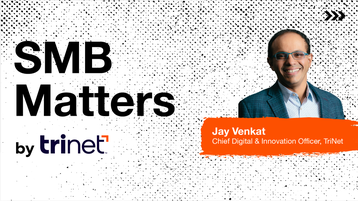
Welcome to SMB Matters.
I am Jay Venkat, chief digital and innovation officer for TriNet. This podcast series takes a close look at the latest news and trends on a variety of topics related to running a successful small and medium size business. Today, I will talk about data-driven digital transformation. Data and analytics can be a huge enabler for small and medium-size businesses to gain competitive advantage.
There are five ways in which small and medium businesses can use data to their advantage.
Number one: Understand your customer better. Collecting, tagging and analyzing customer data can provide a treasure trove of insights. Small and medium businesses can better understand how their customers engage with them, what they value, how they react to changes in product or price, as an example. By enriching direct customer data with third party data, for example, usage of other products or consumer behavior in other forums, small and medium business decision makers can identify how to serve their customers better.
Number two: Improve internal employee productivity. Better real time data and analytics can short circuit expensive manual interventions and allow for faster decision making. For example, one small and medium business owner found that triggers that alert customers service reps about why a customer might be contacting them based on historical interactions and other data can help reduce called handle time and time to resolution.
Number three: Learn continuously. New learning models can help small and medium businesses better understand decision making patterns. For example, a small hedge fund in New York analyzed years of trade data to better understand patterns of behavior from their portfolio managers to help improve decision making and avoid the mistakes of the past.
Number four: Leverage the power of the connected ecosystem in an increasingly connected enterprise. Data with a capital “D” is also the data owned by your collaborators and bringing them in and utilizing that data leads to better outcomes. For example, a small and medium business in the food service space found that valuable data from the restaurant partners around consumption patterns and dining seasonality helped them make much better supply chain decisions.
Number five: Benchmarking. Employers can benefit from understanding how other small and medium businesses like them behave, how they choose benefits, how they structure terms for their employees and make decisions without having to reinvent the wheel. Employees can also benefit from knowing how others like them make decisions. For example, what benefits plans would a family like them choose for open enrollment?
It must be abundantly clear by you now that data changes the paradigm for small and medium businesses in so many ways. An important nuance is that depending on the vertical that is small and medium business is in, the data led applications and services could be very different, very specific and very valuable. For example, a life sciences startup will benefit from understanding what percentage of their revenue is being spent on R&D by other life sciences startups. Similarly, technology companies seeking to fill specific roles in engineering will benefit from salary benchmarking specific to job families.
Tech enabled services companies are best positioned to help small and medium businesses by harnessing the power of data. By utilizing cutting edge learning algorithms, they can capture and codify decades of experience and expertise servicing customers. And by codifying it means documenting and hard coding them into knowledge-based groups, for example, compliance loss and how to adapt to them in a way that can help them serve their customers more effectively. The combination of the services layer powered by data and the underlying technology can benefit small and medium businesses significantly more than a pure software-based player can.
Finally, as AI becomes much more mainstream with various applications, small and medium businesses need to think ahead and prepare for the future. They need to collect and organize unstructured data, for example, notes, emails, texts, so that they can better leverage them as training data sets for learning models that can benefit them in the future. Working with their PEO partner can help them better prepare for a future where data is the new oil.
I appreciate you listening to SMB Matters. If you enjoyed this show, please leave a review on Apple Podcasts, Spotify or wherever you listen to your podcasts. And please share it with a colleague or make sure to subscribe to our newsletter at TriNet.com/Insights. Also, we'd love to hear from you, so please feel free to drop us a line at SMBMatters@TriNet.com. SMB Matters by TriNet is committed to providing small and medium businesses with timely and relevant insights.
Legal Disclaimer:
This podcast is for educational purposes only. With decades of experience supporting small and medium-size businesses, TriNet has unique insight into HR best practices for businesses. TriNet does not provide legal, tax or accounting advice. The materials in this podcast and the options and opinions expressed herein may not apply to your company or scenario, so you should consult with your own advisors on how best to proceed. Reproduction in part or in whole is not permitted without express written authorization from TriNet.


