Navigating the Metaverse: The ABCs of AI and ChatGPT
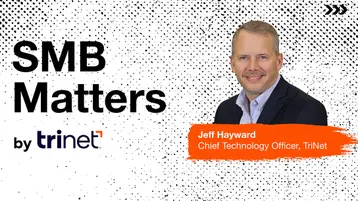
Welcome to SMB Matters.
I’m Jeff Hayward, chief technology officer at TriNet. This podcast series takes a close look at the latest news and trends on a variety of topics related to running a successful small or medium-size business.
Today, I’m excited to share my perspectives on the existing innovations in technology. It’s certainly an exciting time to be a technology leader and to have the opportunity to apply technology in unprecedented ways to drive business value and productivity in every size company. In his latest blogpost, Bill Gates, philanthropist, founder of and former chairman and CEO of Microsoft, wrote that in his lifetime, he’s seen only two demonstrations of technology that struck him as revolutionary. The first time was in 1980, when he was introduced to a graphical user interface. The second big surprise came just last year when he gave the OpenAI team a challenge to train the AI to pass advanced placement biology exams.
They finished the challenge in just a few months when GPT passed with the equivalent of getting an A+ in a college-level biology course. So what exactly is this new disruptive technology? GPT stands for Generative Pre-trained Transformer. And it is what is called a large language model capable of producing fluent text after ingesting billions of words from books, articles and websites. A language model is simply a type of machine learning model which tries to predict the next most appropriate word to fill in a blank space in a sentence or phrase based on the context of the given text.
There are many impressive uses of this technology that can aid the small business user from generating relevant content for your customers, such as news articles, press releases and blog posts, to online store product descriptions. If I had had less time to set up this podcast, I could have had GPT write it for me in just seconds.
There are many incredible applications of this technology—from answering questions in customer service, to sentiment analysis, e-commerce with chat bots that assist customers with online shopping, to my personal favorite with software developer productivity where GPT can complete simple programing tasks by translating the developer’s instructions into actual functioning software code while checking it for errors and freeing up the developer to work on more complex tasks.
So the pace of technology evolution has been increasing and it’s hard not to get caught up in the technology jargon. Increasingly, we are hearing more about Web3, blockchain and NFTs as well as the metaverse.
So what are these technologies? And are they important for the small business to be tracking? The answer is a resounding “yes.” With Web3, we start to move away from the centralization of our data with the media giants to the next generation of the web in which most users will be connected via a decentralized network and have access to and control of their own data.
Think about Apple CarPlay or Android Auto. All of the data resides on your actual phone and the smart screen in the car is just a projector. This allows you to move from car to car, keeping your data with you and just plug it into and using your data where and how needed, not requiring the actual car to store any of your personal information.
For your business, Web3 represents a bundle of technical advances that will allow different forms of interactions online. As a result, this new technology will alter how you connect with your customers, deal with your corporate partners, market your product or service and more. And you can’t fully understand Web3 without understanding blockchain. We’ve all been exposed to blockchain as its most common uses as a public ledger for cryptocurrencies like Bitcoin.
However, there are many more use cases being developed using this technology, including securely sharing electronic health records or Walmart using blockchain in their supply chain to trace their food sources, enabling their mango tracing to go from more than six days to 2.2 seconds. Smart contracting can be used to set up self-fulfilling contracts, gift cards, digital identity authentication. These are all examples of how this technology is being leveraged in current and future use cases.
And finally, I need to mention the metaverse, which is defined as a single shared, immersive, persistent 3D virtual space where humans experience life in ways they could not in the physical world. Or more simply, it’s a collection of virtual worlds where users can meet, conduct business, play games, chat and buy stuff.
Small businesses can use the metaverse to increase their visibility and reach a wider audience. They can use it to provide an immersive and interactive environment to improve customer engagement. It can help small businesses lower their costs by reducing the need for physical infrastructure. And it provides a new, exciting ecosystem allowing SMBs to experiment with new business models and strategies on a more level playing field with larger businesses—enabling more equal competition on a global scale, as even SMBs have seen their employee bases become more decentralized.
Companies are also increasingly using metaverse technology internally for use cases such as conducting training and onboarding.
So while exciting, it’s also important to be careful when investing in Web3 blockchain and metaverse-specific technologies. There are many benefits, but they also come with potential risks. As recent history has shown, the development of these technologies is never a straight line. The next one to three years will be a time of learning, exploring and preparing for these technologies.
So it’s important for businesses of all size to stay aware and invest where the technologies offer sustained productivity gains or competitive differentiation. And I look forward to discussing these technologies in further depth as part of this series. Thanks for listening to SMB Matters. If you enjoyed this show, please leave a review on Apple Podcasts, Spotify or wherever you listen to your podcasts. And please share it with a colleague or make sure to subscribe to our newsletter at TriNet.com/Insights.
Also, we’d love to hear from you, so please feel free to drop us a line at SMBMatters@TriNet.com. SMB Matters by TriNet is committed to providing small and medium-size businesses with timely and relevant insights.
Legal Disclaimer:
This podcast is for educational purposes only. With decades of experience supporting small and medium-size businesses, TriNet has unique insight into HR best practices for businesses. TriNet does not provide legal, tax or accounting advice. The materials in this podcast and the options and opinions expressed herein may not apply to your company or scenario, so you should consult with your own advisors on how best to proceed. Reproduction in part or in whole is not permitted without express written authorization from TriNet.


