Three Pillars of Performance Development: Smarter Process, Stronger Outcomes
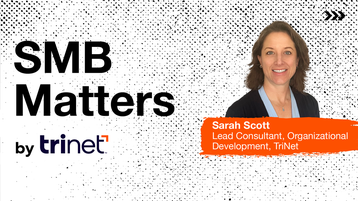
Welcome to SMB Matters, I am Sarah Scott, a Lead Organizational Development Consultant at TriNet. This podcast takes a close look at the latest news and trends on a variety of topics related to running a successful small and medium-sized business. Today I’ll be talking about building out performance development tools that are more than just checking the box.
Let me start with a quick question: When was the last time someone said, ‘Wow, I can’t wait for my performance review!’? Probably not hearing this phrase very often.
I’d venture to say that most people don’t look forward to performance conversations – they may not dread them, but the process may feel more focused on documentation rather than facilitating real growth. And yet, these are the very tools we rely on to drive professional development, engagement, and retention. So today, I want to challenge the way we think about performance development. Not as a form to fill out, or a meeting to endure—but as a system, more so a method, that actually sticks with people!
Let’s start with a reality check.
According to a 2024 Gartner study, 67% of employees say their performance management system is ‘time-consuming’ and ‘not useful.’ That’s two-thirds of your workforce disengaged from a process that’s supposed to help them thrive and grow.
The problem isn’t that we don’t have tools. It’s that we often build them for compliance, not connection. We design them for process, not the individual experience.
What if we approach performance tools the way product teams approach creating new apps? So, think about the apps you use every day — the digital music streaming service, even your fitness tracker. They’re intuitive, they’re personalized, and they give you feedback in real time. There are integrated reminders for taking action, notifications to encourage progress as well as celebrating milestones.
Performance development should feel the same way.
I’d like to share three principles that I believe make performance tools actually stick.
First item being make it human-centered. Design with empathy and connection. Ask: What does the employee need in order to feel heard, and supported? Build a relationship that is grounded in trust and psychological safety. In fact, behavioral science tells us that small nudges—like a reminder to give feedback—can increase participation by up to 40% (according to research from Harvard Business Review).
So, think back to that fitness app and the badges you can earn for achieving those pre-selected targets and customized milestones.
Our second item or pillar would be to make it habitual. James Clear, author of Atomic Habits, says: ‘You don’t rise to the level of your goals. You fall to the level of your systems.’ Build tools that integrate into daily workflows. Think platform plug-ins, communication tools integrations, calendar nudges, or even voice or video notes instead of long forms. Make feedback a recurring 2-minute habit, not a 2-hour task.
And our third and last item here make it data-rich, but people-first. Ensuring that it’s insightful, not just informational. So yes, by all means use data and metrics—but use it to empower, not to punish. Predictive analytics can help identify burnout risks or high-potential talent early on. But always pair data with dialogue.
One example would be, maybe you have a sales consultant exceeding their quota goal earlier in the timeline, it’s important to consider this data with caution and ensure you’re supporting work-load balance and wellness.
As we wrap up – I’d like to provide a quick example. So, a mid-sized tech company I worked with replaced their annual review with a workflow automation platform that consisted of a weekly check-in of 3-questions:
1-What energized you this week?
2-What drained you?
3-What support do you need?
That’s it. No ratings. No forms. Just reflection and conversation. Within six months, engagement scores rose by 22%. Why? Because it was simple, focused on the person, and was consistent.
So, here’s my challenge to you: or your takeaway from today’s conversation:
Don’t just build tools. Build trust. Build habits. Build systems and frameworks that people want to use—not because they have to, but because they see the value. Because it helps them move the needle on their professional growth. Because it deepens their sense of connection and reinforces a quiet, but powerful message: their manager - and their organization - “has their back.”
That’s when performance development becomes more than a process.
It becomes a culture.
I certainly appreciate you joining me today! Thanks for listening to SMB Matters. If you enjoyed this show, please leave a review wherever you listen to your podcasts. And please share it with a colleague or make sure to subscribe to our newsletter at TriNet.com/insights. Also, we’d always love to hear from you, so please drop us a line at smbmatters@trinet.com.
Legal Disclaimer: This podcast is for educational purposes only. With decades of experience supporting small and medium-size businesses, TriNet has unique insight into HR best practices for businesses. TriNet does not provide legal, tax or accounting advice. The materials in this podcast and the options and opinions expressed herein may not apply to your company or scenario, so you should consult with your own advisors on how best to proceed. Reproduction in part or in whole is not permitted without express written authorization from TriNet.


