Cultivating Innovation Through Trust and Empowerment
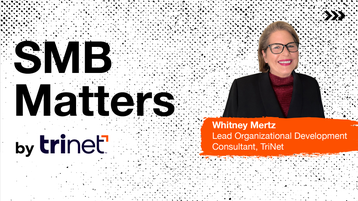
Welcome to SMB Matters, I am Whitney Mertz, a Lead Organizational Development Consultant at TriNet. This podcast takes a close look at the latest news and trends on a variety of topics related to running a successful small and medium sized business. Today, I’ll be talking about the importance of psychological safety at work.
Have you ever had a great idea, but something held you back from sharing it? Maybe you were afraid it wouldn’t be taken seriously, or perhaps you were worried about how others would react. Now stop and imagine. What if your whole team felt that way—if insights and solutions, maybe exactly the ones that were needed, were never voiced.
That hesitation? It kills innovation. But there is a fix: psychological safety.
Today we are talking about psychological safety as one of the most powerful tools SMB leaders have to build agile, innovative teams. It’s not just a buzz word – it’s actually the foundation for organizations that want to thrive and remain agile in an environment that is ever and rapidly changing.
Innovation is especially important for SMBs for growth potential, for competitive edge, for evolving customer engagement, for resilience, and certainly for efficiency.
Research shows that teams with high psychological safety innovate faster, adapt to change better, and minimize costly mistakes. So, what exactly is psychological safety?
It’s the confidence that employees can voice their thoughts, ask questions, bring forward ideas and take risks, without being judged, shut down or even punished for speaking up. It’s not about eliminating accountability. It’s about an environment where ideas are welcomed and mistakes are seen as learning opportunities rather than failures.
It takes action. How can you as a leader foster psychological safety in your organization? I want to share four actionable steps that you can take.
First, allow for mistakes to be part of the growth process. Let’s say that your team is working on a new product or service. After weeks of development, you have high expectations as you launch. But, customer feedback is mixed and sales are lower than projected. Now, if psychological safety is not present, employees may be afraid to speak up about what went wrong, or they may be afraid to take risks in the future; safer to just stick with the status quo. But, in a psychologically safe environment, rather than finger-pointing, the leader brings the team together to create open conversation and encourage more experimentation.
You ask questions such as, “What did we learn from this? What feedback did customers give? How can we improve and try again?" The team then makes adjustment and relaunches to great customer success. When leaders view mistakes as opportunities rather than failures, your team starts to feel safer in taking risks, safer in stepping up to challenges. When leaders create an environment where mistakes aren’t punished but seen as lessons, innovation skyrockets.
Our next action is about feedback. Have you ever been in that meeting where it is just the leader talking while the team just listens? That can be pretty stale. Instead, genuinely invite discussion. Ask your team thoughtful questions including, “What is working and what is not?” And don’t just ask the questions –show your team that you are actually listening by asking thoughtful follow up questions and by acknowledging the various perspectives being shared because when those different perspectives are all coming into the open and building upon one another – that is when the magic happens. And, it’s not just about saying, “We’re open to ideas,” you have to show it.
Go the next step by taking action and following up based on the input you are receiving to let your team know that their thoughts, ideas and opinions are truly valued.
Which leads me to our third action about ideas. Ideas don’t need to be fully developed or be perfect to be valuable. Sometimes it is that rough thought that sparks the brilliant solution. So, make room and time for brainstorming, for experimentation and for constructive feedback. Short but frequent bursts of idea-sharing can actually yield more creativity than those long drawn-out meetings. Invite people whom you typically wouldn’t into the brainstorming to bring fresh insights. When someone shares an idea, acknowledge it, explore it and if possible, act on it. As you move into taking action try new ideas on a small scale before a full rollout. Quick experimentation over perfection. And use feedback from multiple directions to further refine the ideas and solutions.
And our final action, is one we’ve all heard before – lead by example. If you create a culture of fear, where your people are worried about failure or criticism or worse, you block innovation. If you make a decision that doesn’t go as planned, maybe a new marketing strategy that doesn’t exactly land like you planned, for example, you can stay silent and hope no one notices. Or, you can own the mistake and make it a learning moment for your team. Call a meeting and say, “I made a decision that didn’t work out how we hoped. Here’s what I learned, here’s how we’re going to adjust going forward. Mistakes are a part of growth, and I want all of you to feel safe taking risks, also. As a leader, when you admit you don’t have all of the answers you model trust and vulnerability. When you are open and show your team that mistakes aren’t something to fear – they are opportunities to learn, they feel more comfortable doing the same.
Building psychological safety isn’t about everyone just being nice or about taking away accountability. It is about giving people the space to think big and to contribute their best thinking, without fear, so your organization can be more innovative, more adaptable, more resilient.
So, test it out. In your next meeting or 1 on 1, ask one question to get the conversation going – “What is one idea you have that you haven’t yet shared yet?” And then start listening.
Thanks for listening to SMB Matters. If you enjoyed this show, please leave a review wherever you listen to your podcasts. And please share it with a colleague or make sure to subscribe to our newsletter at TriNet.com/insights. SMB Matters by TriNet is committed to providing small and medium sized businesses with timely and relevant insights.
Legal Disclaimer: This podcast is for educational purposes only. With decades of experience supporting small and medium-size businesses, TriNet has unique insight into HR best practices for businesses. TriNet does not provide legal, tax or accounting advice. The materials in this podcast and the options and opinions expressed herein may not apply to your company or scenario, so you should consult with your own advisors on how best to proceed. Reproduction in part or in whole is not permitted without express written authorization from TriNet.


