Part 1―Digital Transformation Is Not Over
In June 2022, TriNet and The New York Times conducted a follow-up to their 2021 study in partnership with Morning Consult to understand how smaller businesses have weathered the pandemic. The 2022 survey of 500 executives from companies ranging in size from six to 500 employees serves as a key barometer into the current and future state of small and medium size businesses. The study included decision makers from a range of industries, including retail, technology, manufacturing, financial and professional services.
“We set out to get the true pulse of all that is happening with small to medium-sized businesses along with those workplace trends,” said Michael Mendenhall, Senior Vice President and Chief Marketing Officer/Chief Communications Officer at TriNet of the 2021 survey. “We wanted to look at the current state of work, focusing on the impact of both the temporary and permanent changes.”
In our second year of surveying entrepreneurs amid the pandemic, TriNet and The New York Times found that small businesses have thrived—with new challenges on the horizon.
Key Take-Aways
Small businesses have thrived. They were a focal point of cultural discourse for more than two years now, grappling with a constant flux of economic conditions. Last year’s survey found that technology upgrades helped small businesses weather the storm and that working remotely helped provide their employees with better work-life balance. Small businesses have largely adapted to conditions brought on by the pandemic, but new challenges have emerged, such as retaining talent and preparing for an economic downturn.
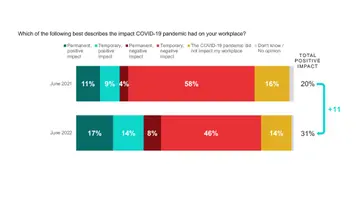
The share of small business decision makers who say that the COVID-19 pandemic has had a positive impact on their workplace has increased since 2021 and so has the share of those who say the impact has been permanent.
Digging Into the Results
Our study found that technology upgrades not only helped small businesses weather the storm, but contributed to employees’ work-life balance. As employees adapt to new ways of working, many say they feel more balanced between work and home, able to manage stress and are more organized than they were in 2021.
- 48% of respondents reported their employees were more balanced between work and home life
- 43% found their employees were better able to manage stress
- 42% said their employees are more organized than before
- 40% reported that their employees are better able to be creative in their roles
While almost half of small business decision makers say the pandemic has had a temporary, negative impact on their workplace, since 2021 they have become more likely to say that the impacts have been permanent. Morning Consult reports that overall, small business decision makers are feeling more focused, motivated and productive than they were in 2021.
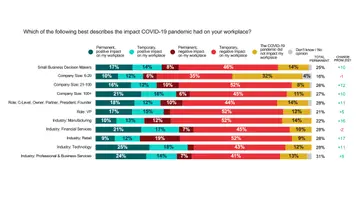
The group size that reported be most negatively impacted by the pandemic were small businesses with 21 to 100 employees—62% had a temporary or permanent negative impact. When it came to impacted industries, manufacturing and retail businesses reported the greatest negative impact with a respective 64% and 71% of businesses reporting a temporary or permanent negative impact.
The Bottom Line
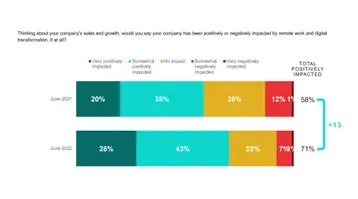
Small business’s investments in technology appear to be paying off. Survey respondents were far more likely than last year to say that digital transformation has had a positive impact on sales and growth. Small business leaders reported that sales and growth has been positively impacted by remote work and digital transformation has increased 13 points from 2021.
Looking to the Future
Despite the challenges that small businesses have faced over the past three years, business leaders still feel optimistic about the future. Small business decision makers still feel very prepared to handle key workplace scenarios, and they’ve become more prepared to “maintain information security” and “maintain high levels of productivity.”
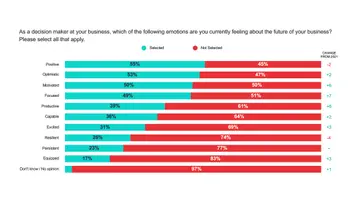
Overall, small business owners are more positive about the pandemic’s impact on their companies and the future of their business. Compared to last year, a significantly higher proportion of respondents said that the pandemic has had a positive impact on their business. While positivity has declined slightly, it remains the top emotion about small business decision makers’ businesses.
In thinking about the future of their company, business leaders reported they felt very or somewhat prepared to handle the following scenarios:
- 89% felt prepared to manage payroll and benefits for employees
- 88% felt prepared to maintain information security
- 83% felt employees were communicating effectively via remote environments
- 86% felt prepared to retain current talent
Overall, small business owners feel positively about both the pandemic’s impact on their companies and the future of their work. Our study found they generally feel well-equipped to tackle whatever the future holds.
Look for more highlights in upcoming articles of this series as we take a deeper dive into other aspects of the study including:
- How digital transformation has helped businesses prepare for what’s ahead
- Remote work and its impact on workplace culture
- What this all means for the future of business
Read the full interactive study on our paid post with The New York Times at How Small Businesses Have Handled Another Unprecedented Year.


