Part 3―Remote Work and Its Impact on Workplace Culture
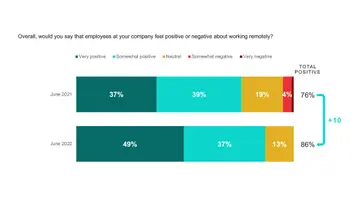
Small businesses have adapted to the new normal of remote work. Positivity about remote work improved by 10 percentage points from 2021; virtually no small business decision makers surveyed said their employees feel negatively about remote work, a marked difference from last year.
Positive Attitudes About Remote Work
Small business owners interviewed said working remotely helped them expand, making it easier to meet with clients via video conferencing and allowing them access to a wider candidate pool. Employees enjoyed the flexibility of working from home, with some relocating to other parts of the country.
Positivity about remote work has improved 10 points from 2021, and now no small business decision makers surveyed say their employees feel negatively about remote work.
As employees adapt to new ways of working, many say they feel more balanced between work and home, able to manage stress, and organized than they did in 2021, relative to before working remotely.
Our study asked decision makers about how their employees were impacted by remote work compared to before working remotely:
- 42% reported feeling more organized—up 16% from our 2021 survey
- 43% reported feeling they were better able to deal with stress—up 14% from our 2021 survey
- 48% reported feeling more balance between home and work life—up 6% from our 2021 survey
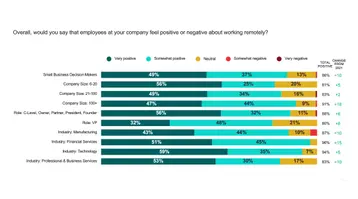
Since 2021, overall positivity about remote work has increased most among large small businesses and in the financial services industry.
One founder had a complete change of heart over the question of remote work. Barbara Morrison founded TMC Financing, a small firm in the Bay Area that provides SBA commercial real estate financing, more than four decades ago. She believed strongly in the notion of traditional corporate culture. “I did not like the idea of remote work,” Morrison says.
However, lockdowns forced Morrison to grapple with working from home and learning to adapt to remote conferencing. She’s found that remote work allowed her to hire candidates from around the country as she was no longer limited by a candidate pool local to their home base. Perhaps most importantly, she reports her company has experienced record levels of production.
Positive Impact on Company Culture
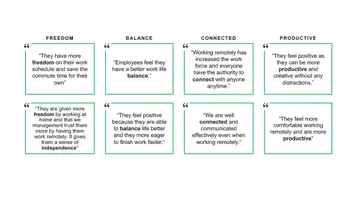
Encouraged by what they’ve seen over the last year, each small business owner interviewed says they’ll continue a remote or hybrid working model moving forward. Similar to 2021, key reasons that employees are feeling “comfortable” working from home center around freedom and balance. This year, many responses also regard “connectedness” and “productivity.”
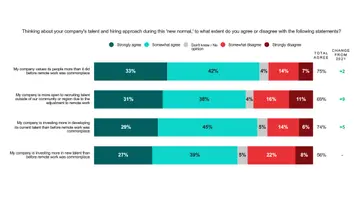
A total of 67% of survey respondents indicated the technologies they adopted impacted their workplace culture “very positively” or “somewhat positively.” Talent remains a priority for small business decision makers: they value their people, are investing in developing their people, and are focused on recruiting. Openness to recruit outside of region has increased since 2021.
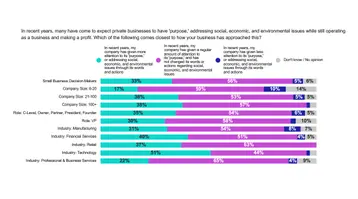
Despite an increase from 2021, small business decision makers have not overwhelmingly changed their approach to DEI and half say there has been a normal amount of attention to DEI at their company in recent years. In the last year, companies have turned their focus to diversity, equity and inclusion (DEI) training and implemented new processes to ensure equity in the workplace. The following groups have given more attention to their 'purpose,' or addressing social, economic and environmental issues through its words and actions:
- 50% for technology business decision makers
- 49% for financial services
- 40% for retail businesses
- 42% for manufacturing businesses
One-third of small business decision makers say their companies have given “more attention” to “purpose,” while most (56%) have given it a regular amount of attention.
Coming Up
Look for more highlights in our final article of this series as we take a deeper dive into what this all means for the future of business.
Read the full interactive study on our paid post with The New York Times at How Small Businesses Have Handled Another Unprecedented Year.


