The New World of Work with Keith Ferrazzi
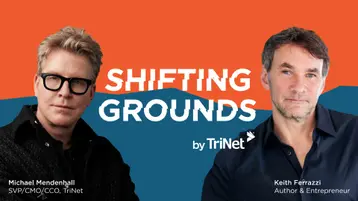
Michael Mendenhall: Welcome to Shifting Grounds. I'm Michael Mendenhall, the Senior Vice President, Chief Marketing Officer and Chief Communications Officer at TriNet. Many of you are probably wondering what TriNet is. TriNet is a full-service HR solutions company. We really do everything from onboarding all the way through to healthcare solutions for companies. We are committed to small and medium-sized businesses, and supporting and empowering their growth, and most importantly, enabling their people.
We are dropping our podcast, Shifting Grounds, the third Tuesday of every month. We're excited today to actually flip the format and have our host as our first guest, Keith Ferrazzi. Keith is a New York Times bestselling author, speaker, entrepreneur, investor, philanthropist and executive team coach. I don't think there's much else he could do. He actually helps executive teams harness sort of radical adaptability. We're gonna talk more about that today and co-elevation to transform enterprises in what we know is a very unpredictable work world. As Founder and Chairman of Ferrazzi Greenlight and its Go Forward to Work Applied Research Institute, he helps with top organizations to maximize team performance and achieve transformative outcomes of which many people have been going through in the last 18 months.
Welcome, Keith. Hey, Keith, I wanted to talk about where you are, quite frankly. I know with a remote workforce, we're all over the place. Where are you based now?
Keith Ferrazzi: Well, I just landed from Costa Rica into Los Angeles. And I didn't skip a beat for work. So, you're absolutely right, we can be anywhere these days.
Michael: Yeah. Well, so Costa Rica to California, I just recently read that a lot of the talent, producers, actors, etc., are all leaving California, going to Florida, Texas, etc.
Keith: That has a lot to do with the damn tax rate out here, which is absolutely ridiculous.
Michael: Yeah. Well, and I guess also the tax rate for businesses, which is, you know, not very becoming. Well, that's awesome. I'm in Montana, you know. I moved up here to Big Sky during COVID because there was a way to get out and actually do things where I wasn't trapped in my home for, you know, 12 months. And so, I was one of those that sort of left the state of California and enjoying it up here. And I know my entire team, quite frankly, is remote. We'll talk more about this. And they are scattered all over the country. And we're gonna actually remain remote for a good period of time. So, it'll be interesting.
Keith: So, you're gonna continue to hang out there with the bear and the moose for a while or are you gonna join civilization at some point?
Michael: Well, I do get to New York and L.A. quite a bit. And actually, it's crazy from Bozeman, Montana, have direct flights into JFK and actually into Los Angeles. So, it actually makes it quite nice. But you know what’s going to be fun for us? The first 150 listeners to this podcast are going to get a free copy of your book. We’re going to talk about that. It’s newly released “Competing in the New World of Work,” with the code “shift”—s-h-i-f-t—if you go to TriNet.com/shiftinggrounds, you’re going to receive a free copy of the book and again, that’s TriNet.com/shiftinggrounds with the code “shift.” So that’s pretty exciting. It’s a great new book. We’re going to talk about that in a little bit. More details provided at the end of this episode.
Keith: Michael, that's very generous. I was so proud the other day that Harvard picked it as their top pick of a book coming out of the pandemic. So, it's very generous of you to be giving that to your members.
Michael: Is this New York Times bestseller already?
Keith: It's on its way. If I look at it, we've probably sold about 15,000 books just in the presale. So, pretty excited about the book—a lot of pent-up demand.
Michael: How long, Keith, did you work on the book?
Keith: Well, it's a great story, actually. So, right at the peak of the pandemic, as soon as it came out, I remember I called you, actually. Right at the peak of the pandemic, I realized, "Damn it, this is one of the biggest inflection points in business history and we better use it effectively." And so, my big fear was that we would crawl out of the rubble and go back to old ways of working, instead. And I remember I called you about this. I said, "Let's not go back to work. Let's go forward to work." And it's actually right then that we conspired this podcast. And so, thanks for being a partner from the very beginning. So, it's a two-year research project.
Michael: Yeah. Well, what we know is, you know, certainly small to medium-sized businesses, over 80% immediately went remote, right? And we knew that they were just really trying rapidly to figure out, how to communicate with each other—how to go to market in a different way. The behaviors shifted rapidly. And we know that over 70% of them acquired new technology during this period. And to your point, you know, a lot of people have said, “We've jumped seven to 10 years. And it happened so quickly that there were all kinds of issues around how to communicate, how to continue building culture in these companies. So, just massive shifts and behavioral changes that happened, like, overnight.
Keith: And I'll tell you, Michael, my fear is that acceptable is the enemy of the possible. What I mean by that is, I find that many of us are so thrilled that we did this. It was acceptable. We put the technology and we went remote, our organizations survived, some even thrived. But the big challenge that I found is that we didn't go far enough, in many instances. We didn't truly reinvent the way we work. We just put tools on the old way we worked so that it was acceptable, but not what's possible. And that's why I'm very excited. We've got one of our shows coming up just focused on the best practices of “how do you really leverage these tools that we've paid for and put into place and leap forward?”
Michael: Well, it's gonna be so important because we know the 60% are gonna remain remote or hybrid, so they're gonna continue to deal with some of these issues. And we'll talk a little bit about that because we've certainly seen, you know, a huge uptick in the importance of mental health through this whole period. And so, there's a lot of new things that these companies are having to deal with separate from, you know, this is the old way we were restructured. Now, what do we do? Because procurement has changed, go-to-market has changed and behaviors. And one thing we know is: I think most companies are like, "We don't wanna go back. We're not gonna go back." And also, the employee base doesn't wanna go back, so...
Keith: Yeah. They have put their foot down, haven't they? Pretty clearly.
Michael: Yeah. You've been doing this work for over 20 years and you know. These last 18 months as we're talking have been really just rapid change. We know that velocity and adaptability—and I wanna get into the adaptability piece—is critical and has become a competitive differentiator. Can you talk to us about what you've seen in 20 years? What has happened in the last 18 months? And what do you foresee happening in probably—and I don't even wanna say two to three years. What's gonna happen the next six months?
Keith: Indeed. What a great tee-up. Thank you for that because I have seen over the last 20 years that we've been moving into a radically volatile environment. And the problem is that, over that period of time, we've been able to cling by our fingertips on the ledge of old ways of working even though our customers are changing expectations. Competition is biting us in the butt, consistently. And the shifting landscape...and what a beautiful title of the podcast—shift. With a shifting constant landscape, it's become like an earthquake. Now, what happened then during the pandemic is we just couldn't cling by our fingertips to old ways of working anymore. We had to reboot. We had to reimagine. Now I'll give you a “for instance.” We practiced something during the pandemic that I called crisis agile. So, agile is when you wake up as a business and you work in small sprints, constantly reassessing what has changed and what we need to do differently. Now, many organizations set these annual plans or quarterly lookaheads. And the reality is that we've gone to one a week to every other week basis. Ask the question, what is changed in our customers? In our competition? In the landscape? In macroeconomic policy? We've gotta be constantly looking around corners.
Now in the crisis, we had to do that because it was so obvious that everything was changing. As we come out of the pandemic, I believe that the new operating system for organization is going to be agile and adaptability—which requires us to hold on to this constant look-ahead. I'll give you a very short “for instance.” There were companies out there that because they had good foresight processes, because their executive team for five minutes a month talked about what risks were coming down the pike and what opportunities they saw, five minutes. And then if something seemed important, they put it into a separate meeting. That caused Lockheed Aerospace to go fully virtual in February. And I know organizations that have big operations in China that were caught on their heels on March 13th, 2020, even though they had all of the data. So, I want all of us to recognize that we're moving into a world where foresight and adaptability becomes a critical competency of leadership. But it's not just the leader, it's the whole team. And we've gotta curate time to do that on a monthly basis. Look around corners. Readjust and create a radically adaptable, strategic plan.
Michael: You and I, if we go back 20 years, and maybe even 10 years...you know, many of these corporations, whether it's small businesses or enterprise, you know, would talk about...and we've mentioned it earlier, you know, five-year plans. Then people said, "No, we can only do three-year plans because, you know, things change so much." And I've been telling businesses, you know, three, not even a year. Tell me what's happening in six months." The shift in technology, this shift of behaviors that's happened is happening so quickly. What is your opinion about planning? You know, you talk about the ability to be agile, having some level of velocity, having flexibility in how you work as a team. Talk to me about what you've seen there. And how should companies prepare for this?
Keith: I'm smiling because it's very clear that you read the book. So, first of all, on the planning piece...and we do go back at least 20 years. I remember when I first met you, you were probably wearing Mickey Mouse.
Michael: This is true.
Keith: Not because you were a child. Because you were a big shot over at Disney. But look, I wrote a piece during the pandemic that was focused on what I call continuous and crowdsource planning. I gathered about 30 or 40 chief financial officers of organizations and asked the question, "How have you been forced to pivot the way in which you plan? And is there any aspect of how you now plan that you wanna hold on to and not go back to old ways of working?" And the answer was two things. Number one: 100% continuous. So, it was no longer a three-year plan, five-year strategies. They literally, as I mentioned earlier, they were working on a weekly to monthly basis trying to figure out what their year looked like, what they needed to do differently. And so, the continuous process was put into place.
But the other thing that I was very excited about—Unilever and others did this. They decided to go crowdsourced. Because they were hybrid, instead of cascading the financial planning process, where you start with the CFO and the CEO and then you go to the executive team. And then once they lock in the plan, they go down to other parts of the organization. Now, what they were doing is they were pulling the entire company together in town halls. They were going into breakout rooms, answering questions of where individuals saw growth opportunities, coming back into the main room, wrestling those, pausing the meeting, analyzing the data, coming back again a week later and redoing the conversation on an iterative basis.
So, what we have found is the ability to crowdsource innovation, crowdsource growth, crowdsource ideas. There's a company called LyondellBasell that actually brought their entire vendor community into the process of looking around corners and planning. Now, I believe we can also bring customers into the process and clients into the process, as I've seen companies do. So, I think that we are now totally open-ended. I call it teaming out where anybody can be involved in that planning process and should be to make sure that we have the boldest and most innovative insights into that planning process. So, continuous and crowdsourced.
Michael: I wanna go back to the crowdsource relative to your customers. You know, at TriNet, they really are the center of all of our dialogue, all of our conversation and our planning. Do you have examples of how other companies have used their customers in this sort of virtual world we're in?
Keith: Well, I will pick one of your customers, who is one of your most evangelistic customers out there and I'll use that as an example. The company is called Ferrazzi Greenlight. And I'm a very proud customer, but I'll tell you what I did. At the peak of the pandemic, this research, which turned into the book, is with our customers and our clients. We reached out to those individuals we were working with and we invited them into a series of roundtable dialogues, where the customers actually helped us look around the corner. They actually re-engineered entire new product lines. We created an entire new division of the company around hybrid workshops, just because our customers ordained us to do so in these small dialogues.
I would have never been able to have an entire new product development team as bright as the literally 2,000 individuals that we had engaged in the research project that were all prospects and clients. And as a result, we had one of the best years we've ever had because we engage these individuals in mutual planning that's of service to them. Similar, Michael, to what you do. I mean, you work so hard as TriNet to bring your customers into the dialogue and serve them. And I think all of us should start looking at how do we do that with our customers. And it's so much easier in a hybrid world where people don't have to get in a car or get in an airplane and fly somewhere. We can engage richly and deeply with our customers and gain the benefits from a revenue perspective, and from a research perspective, and a product development side.
Michael: And that was all done digitally?
Keith: 100% digitally.
Michael: So, we talked a little bit about community, which is what we were doing here. And one thing we have seen is the need for even more communication, whether to your employee base, your customers or any of your stakeholders—through this sort of 18 months of being remote, being digital, that the communication is now more important than it ever has been. Do you agree with that?
Keith: Not only do I agree with it, but I've seen some extraordinary best practices around that type of communication. So, if you take a look at a standard organization that would do a town hall and what you're suggesting is—maybe invite more constituencies into that town hall because you can. Federal Express moved from a meeting that they used to have of their leadership that was hundreds, to a meeting that they would have with their leadership, which is thousands. But the difference then is, make your communication two-way. That's probably the biggest opportunity that many organizations have missed. So, we communicate. And instead of thinking about it as a broadcast message, think of it as a way in which to capture information two ways. Now, there's two ways to do that. One way I alluded to in the prior conversation we were just having—using rooms and breakout rooms, get people together, have a breakout room, have a question, have a SharePoint or a Google Doc of some sort...
Michael: Now you're talking digital, right, in these break-out rooms?
Keith: These were all digital. Exactly. Digital breakout rooms with a document that's open so that you can capture information from three or five people chewing on a question. But the other thing, and this is a major area of shift in work, it's called asynchronous collaboration. So, one of the things that we recognize is that virtual and remote is not a binary idea—where either, it's not that we're gonna be physical, hybrid or remote. There's a final area of collaboration which is more powerful and actually underutilized. Fewer than 15% of companies in our studies are actually using asynchronous collaboration. This is when you ask a question in a shared document that anybody can write in. You send it around to a group of individuals.
So, I'll give you an example. Instead of having a conversation with 12 people in a room, you know, whether it's a virtual room or a physical room, let's invite 12 people into a dialogue on a question in a shared document. So, the question might be, what are the greatest risks we see to our business in the next six months. And we send it to 12 people. Everybody can see everybody else's answers. They can debate, "Oh, well, what about this?" "Well, I don't think about this, I think about this." And then they might say, "What about getting this person involved?" Now, all of a sudden, you have 35 people involved in the dialogue and they can do it on their own time. We don't have to have those constant monotonous meeting after meeting after meeting.
Michael: So, a question there. We use Microsoft Teams. We tend to do that at TriNet through Teams. What other sort of applications do you see that actually do that well?
Keith: Well, Teams is a fantastic solution. Microsoft has really jumped in full bore. So, you can use Teams rooms to have these conversations, just like you can use a Slack room to have these kinds of conversations. You can use a Google Doc or you can use, for Teams, a SharePoint document. So, it doesn't... what I found is that I go into a company and I guarantee you, all of you out there have the tools available to you. You're just not realizing that you're not stretching the tools to think and work differently. The biggest shift... a friend of mine used to be the chief operating officer of Delta Air Lines, Gil West. He moved over to Cruise, which is the self-driving automotive car unicorn company. And he said the biggest lesson he learned is in the olden days, if you wanted to collaborate or if there was a new idea, he used to say, "Let's get a meeting together." And Cruise, they looked at him and say, "Are you kidding me? What a waste of time. Let's collaborate in the cloud. Let's collaborate on Teams. Let's collaborate in a Google Doc. Then, once we know everybody's opinion, then we can have a small meeting with exactly the right people and we land the plane with a decision.” That's a big shift. Collaboration does not start with meetings.
Michael: That's a great point. And that leads me to something that was in the book that I wanna talk to you about. And that's sort of the old world and the new world. The old world of working and the new world of working. And you really have detailed those out in a figure that was pretty awesome. Talk to us about that because that has to do with the adaptability, you know, stretching the technology and the applications and how you apply them to be more efficient. But talk to us about these two worlds and what worlds are we in now and where's that world going.
Keith: Well, here's the opportunity, Michael. And this is why I love this podcast that you've created. You're inviting your customers, you're inviting the world to live in the new world. And right now, we're one foot in the boat of the old world and one foot in the boat of the new world. And some of us are deciding which direction we wanna go. This idea of, are you gonna really embrace the tools of remote and hybrid work and forget about thinking of it as binary? Are you gonna say, "We're going to embrace remote and hybrid. And we're gonna use remote work as an opportunity to give people flexibility. We're gonna use remote work as an opportunity to get more involvement and more ideas engaged in decision-making, instead of just who is physically around you. And as a result of that, then we're gonna go to physical meetings and we're gonna go to physical work when it's emotionally powerful, when people have crunchy issues that you need to look at each other face-to-face in the eye and work through, where you need a long, slow, dinner to create empathy between two individuals, where you wanna celebrate emotionally and lift each other's energy up positively." That's where you lean into the physical world, and not just assume it's binary, right?
And then you'll go in the new world of mental well-being. In the old world of mental well-being and resilience, and I know we wanted to get to this, that the old world, your mental well-being was your business, right? You kept it to yourself. It was maybe even shameful if you felt stressed or if you fell on the rocks. In the new world of work, we wear it on our sleeves. Even the most grizzled senior executive, senior leader is willing to share vulnerably about their fears, about the challenges that they have, personally or professionally. And as a result, invite the team in to support each other. This movement from individualized take care of yourself resilience, keep it in the shadows, to openly what I call co-elevating, where people are committed to each other and lifting each other up. That's an old and new world. So, the book lays out nine different critical chapters of old and new world. Resilience is one of them. Collaboration is another. And there's so many others, of course. But I know you wanted to pick on resilience, so I don't know if this is a good segue into that.
Michael: Well, I wanna get to that. But now we've talked a little about this sort of mental versus physical. And certainly, when you look at the insurance carriers, we've always sort of diminished the mental and have covered sort of more of the physical part of your health. And now we're seeing, you know, based on this idea of remote work, one we saw, you know, many female executives and business workers move out of the workforce because of the stress that was put on them, relative to being basically, you know, the student-teacher at home, the kids were at home, the workload just sort of amplified. And so, you talk about sort of the mental health there and what has happened in this exodus of female executives. You know, there's a lot that's happened around this. Do you think... I know companies are highly, highly focused on this right now, is the mental well-being that the insurance companies, the carriers or people will start to recognize it's as important as your physical? What's your opinion about that?
Keith: 100%. And I think, if those of us who have been attuned to mental well-being for a long time, and I've been an investor, I've been a seeker in the space of mental well-being for a very long time, knows that in fact, I think, mental well-being could actually be at the core of physical well-being. I lost my sister to....
Michael: I’m sorry to hear that.
Keith: Yeah, thank you. I lost my sister a couple of years ago to mental well-being, but it showed up in diabetes, it showed up in diverticulitis, it showed up in liver cirrhosis and drinking too much. It showed up in all of these physiological diseases that actually at the core was around mental well-being. And I feel that if we have... and we're never gonna put the genie back in the bottle. Individuals have realized that they have to take care of themselves. We pushed ourselves and we pushed each other to the stress point and we gave people some degree of permission to take care of themselves and to be vulnerable. We're never going back.
Michael: And do you think it is the responsibility of businesses to focus on this relative to their employees? When you think about, you know, the employees saying, "I like the work-life balance, but I think I'm working harder when I'm working remote and that I'm working longer hours.
Keith: I'm gonna be flip about this. It depends upon whether or not you wanna have the richest and most robust work pool or not, right? If you don't give a damn about your associates' mental well-being, their flexibility, their energy, their engagement, their sense of belonging, their sense of commitment to you and to each other, then fine, don't give a damn. Then guess what you're gonna have as an employment pool to be able to choose from? So, it's really your call as to what type of employment pool that you wanna choose from will be determined as to whether or not this becomes an important issue for you.
Michael: I think it becomes incredibly important based on this new work environment we're in. And, you know, clearly, we see that in multiple pieces of research that, you know, this is going to become incredibly important relative to work-life balance in this new environment.
Keith: Can I take the flipside of... So, I was very provocative and a little bit, you know, aggressive on that stance to those of us who are listening, who own businesses, right? But now let me take the flipside. Let me talk to the associate. You have to take responsibility for your resilience, you have to take responsibility for your sense of belonging. Don't sit there in a nest with your mouth open like a little bird chirping and wanting to be fed. At the end of the day, you have the opportunity to take care of your own routines, you have the opportunity to build relationships in the workplace, you have the ability to lobby your organization to adopt new policies and new HR procedures. So, I really, and in the same regard that I fully believe that we as business leaders, and myself included, have to take a commitment to this. And the flipside is: I will definitely reward the associate and the employee, that is the community leader, that is the individual driving resilience, not only for themselves but for their peer group in the organization. So, I think there's an opportunity that we can redefine ourselves and our brands as employees, if we take it upon ourselves to become more resilient and help our teams become more resilient.
Michael: There's two things that pop up in research that we've seen, certainly with small businesses. I think it applies to enterprise, as well, is this idea of the culture of the talent. So, as you think of resilience, the talent that you have and the retention of talent and the acquisition of new talent. You know, some people said it's the Great Resignation. We really think it's the redefinition of the work and the redefinition of jobs. And so, do you think that is a piece of what we're seeing relative to the resilience and people sort of taking charge of their own life and saying, "This is what I want. And this isn't what I want. And so, therefore, I'm going to redefine my work environment.".
Keith: The biggest shift that I have seen that allows a successful engaged employee body is when we decide to successfully engage our employee body. What I mean by that is this: we used to think of work and associates as a hub and spoke to leaders. There are leaders and then there's team members. Each team member reports to the leader. It's the leader's responsibility to take care of the employee. And the reality is that what we saw more of during the last two years... and I think I just wrote a piece on this, and I haven't pushed send yet to my editor. But the new world of work has a collectivism associated with it. It's a collectivism that means that we will lift each other's energy up. We will hold each other accountable. And if an organization wants to think that it's your job and your HR policies that are responsible for everybody's energy, everybody's mental well-being, recruiting new individuals, onboarding them successfully… If it's all hub and spoke to a central authority inside the company, you're not gonna get it done. There's too much. We raised the hurdle of what it takes to caretake and associate.
So, don't try to control it yourself. Make your associates emboldened to caretake each other. And if you are able to unleash a level of peer-to-peer support, peer-to-peer engagement, peer-to-peer coaching, peer-to-peer criticism and feedback—all of those things. If you start to shift the contract from hub and spoke to a leader, to the word that I created, co-elevating, within an organization, you adopt a very different solution that you didn't have before, a very different lever that you didn't have before and a very powerful one. I think that's a new shift to contract of even redefining leadership, as a hero of a leader on a podium looking down, helping individuals and lifting those individuals up and redefining the social contract of a team to help each other.
Michael: So, we talked a lot about people. I wanna talk a little bit now about technology and how it enables or doesn't enable your company in future-proofing your company. You know, we hear so much about AI being used in CRM, AI being used in chatbots, quantum computing, blockchain. We're seeing quite a bit of that, certainly in the digital currency space—automation becoming incredibly important and so much about sort of Web 3.0. Where do you see this going? And how does that work with people? We tend to talk technology and then people. And I think, you know, when you think about some of the things we started looking at, and are beta-testing, and have released, are chatbots that actually do have people involved, and it's conversational marketing or conversational go-to-market where you still have a human interface. What's your opinion about all of these technologies? How they're used? And where do people fit in?
Keith: The CIO of Aflac, Rich, is an incredibly insightful person who brought a word to me that I'm gonna give you to be able to re-engineer your thinking around technology. And I agree with you, Michael, we've always thought, "Okay, we've got all of these technologies and then we've got people." What if you start thinking about people and technology with the following word, bionic? Michael, do you remember the "Six Million Dollar Man"?
Michael: Oh, God, yes. Oh, God, yeah. Farrah Fawcett.
Keith: Yeah, that was the other one, right, “Bionic Woman.” But we can make...so, that's why...I went for the bionic man, you went for the bionic woman, but we can make him faster, faster than he was before, etc. That's where we're going. Every time you adopt a technology, I want you to ask the question, how does this technology help my associate be bionic? So, if you take a look at call centers, right...of course, there was one of the funders of our research early on was a company called LivePerson. And you know, these chatbots, I started seeing how these chatbots weren't thought of by some companies, which is a replacement, but actually, an augmentation, where they become marbled into the associate's way of engaging with the customer to be able to serve that customer in significantly different ways.
Now, that is fundamentally a different way to think about it. When you think about your CRM technology... you and I both old marketers from the day, right? You're still an amazing marketer. I've left that world behind so I'm not up-to-date on all the technology. But remember how difficult it was because we had CRM technology? We were forcing people to use it. We never asked ourselves, "How does this enable the sales rep?" We were just trying to get them to load the data to be able to report data back to the enterprise. But now the question is, how does all the technology make your sales rep bionic? So, AI, machine learning, crypto, all of these. You should be asking yourself, how was it marbled into the human, making the human the best human possible? Because we're never gonna get rid of human. We're only gonna enable the human to rise up to a level of their greatest capability. And that's what we should be looking for.
Michael: So, that brings up a point that's really interesting within your book around foresight. And it's not just about technology. And one of the most interesting things is when you go back and you think about Steve Jobs and the iPod. You know, here we were carrying around all these cassettes, a cassette player or remote cassette player. And he realized, you know, look at the human experience and how do we improve the human experience. And then begins to develop this digital technology both in hardware and software. So, when you say foresight, you know, when people have to look sort of 10 years out when things are changing in six months, does it all really go back to the human experience? And how do we improve it? Whether that's in B2B, B2C or B2B2C?
Keith: Yeah. First of all, I'll just reveal a little embarrassment. I still have not had the courage to get rid of stacks and stacks of DVDs that are sitting in a closet of mine. So, this shows why I'm 55 years old and still trying to struggle out of old ways of thinking. But, look, the thing about... I can't be Steve Jobs and I don't expect any leader to have that kind of foresight and brilliance. And it's dangerous, by the way, if any of us think that we can be. It's dangerous to think that the ecosystem, and the influence, and the insights come from our singular experiences.
And to me, what's been a wonderful opening opportunity in the past couple of years is the recognition that we can invite a more inclusive set of voices into the innovation process, into foresight. And this is where it's interesting because, you know, we can also talk about diversity and inclusion in this discussion and what we saw in the last couple of years. But in this conversation, the question is, if you've got a diverse associate base, whether it's, you know, diversity of all types and then the question is, are you including them. And if you look even broadly, what we were talking about before, think about your vendor base and your customer base as a potential for diverse, inclusive thinking. I think that the real system of foresight in the future is how do we marshal a radically diverse set of inputs to make insights extraordinary.
Now, there's an old myth—old world, new world—there's an old myth that the more people you get involved in decision-making, the slower and the more consensus-oriented it'll be, and therefore it'll be mush. That is an old myth. We've gotta reinvent the way we get bold ideas to come out of more inclusive input. And it's featured in the book in the collaboration chapter. But that's gonna be a big deal. Foresight is, again, crowdsourced.
Michael: Well, like, we're gonna run out of time and I wanted to talk all about collaboration. Hopefully, that'll be on another podcast. But I did wanna leave with one thing. What have you seen most recently in the news that, as it pertains to this whole sort of new work environment, that would be interesting to our listeners?
Keith: Well, we talked about what we've seen around the Great Resignation in the news and it's just constant right now. And I feel that we've got to see this not as something we just need to struggle and get through. We've gotta see it as a fundamentally different set of shifts of the population. It's so funny. You know, we sit there and we used to—before the pandemic—we gave a hard time to the millennials, you know, like, "How dare them want purpose in their work? How dare them want balance in what they do? How dare them wanna find joy in the workplace? We've given that up a long time ago. How dare these people expect that kind of thing?" Now, all of a sudden, we started demanding that at the peak of the fractured, frustrated, fearful world that we were living in in the last couple of years. That's not gonna change; it's not gonna change. The sands have shifted and just as your customers have shifted, their expectations, our employee base has as well—and we've gotta serve them.
Michael: Yeah. That's why we believe that it's not the Great Resignation, but the great redefinition of the workplace. And I think that's probably more appropriate. Keith, it has been awesome and such a pleasure having you. We can't wait to listen to the rest of these podcasts with you hosting them with business leaders in the coming episodes. At TriNet, we are committed to the growth of small businesses, and we wanna bring you timely and relevant business content. Shifting Grounds drops the third Tuesday of every month.
Don’t forget our first 150 listeners are going to get a free copy of Keith’s newly released book, that Harvard has just recognized in a major way “Competing in the New World of Work” with the code “shift,” go to TriNet.com/shiftinggrounds to receive your free copy. And again the code word is “shift”—stay tuned for full details. This has been a great pleasure, Keith. Thank you for spending the time with us.
Keith: It's been my pleasure, and it's always wonderful to dip in with you personally.
TriNet USA, Inc. is sponsoring a Shifting Grounds Book Sweepstakes and you could win one of 150 signed physical copies of the book “Competing in the New World of Work” by Keith Ferrazzi valued at $30 each! To enter to win, go to trinet.com/shiftinggrounds, enter redemption code, SHIFT, fill out the form and, if you are one of the first 150 eligible individuals to submit your details, then we will ship you a copy of Keith’s book to the address provided. You must be a U.S. resident, with a physical postal address—no P.O. boxes, and be over 18. NO PURCHASE NECESSARY. Ends March 31, 2022. Open to U.S. residents. Void where prohibited. For official rules, visit trinet.com/ShiftingGroundsBookSweepstakes.


