Reinventing How We Work and Maximizing Remote Collaboration
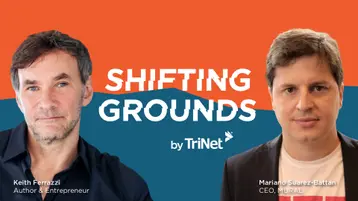
Keith Ferrazzi: Hi, I'm Keith Ferrazzi. And I'm the host of Shifting Grounds by TriNet. TriNet is a full-service HR solutions company committed to empowering small and medium-sized businesses by supporting their growth and enabling their people. You can catch our new episodes on Shifting Grounds on the third Tuesday of every month on Apple, Spotify and RISE.trinet.com.
We have a particularly special guest today. I say it’s special because Mariano Battan is special in his own right, but he’s special because he’s our very first guest. Now, Mariano is the cofounder and CEO of MURAL. MURAL, if you don't know what MURAL is, it is a platform that revolutionizes innovation, collaboration, and frankly, the way we conceptualize work. A lot more about MURAL just in a bit of a moment, but I want to talk a little bit about Mariano. Mariano is an incredibly accomplished individual, EY Entrepreneur of the Year finalist. And let's cross our fingers for that one in the near future. A unicorn founder, which is that rock star status of an individual who prior to IPO busts through the billion-dollar valuation mark—and that was in Mariano's distant past. Back in 2021, he hit a $2 billion valuation.
Mariano, I want to welcome you.
Mariano Battan: Thank you, Keith. And yeah, always problematic to have Mariano as a name and Suarez-Battan, compound last name. But right now there's a character in Disney's "Encanto" called Mariano. so now it's famous.
Keith: [Speaking in Italian]
Mariano: Mariano.
Keith: Perfetto. Hey, listen, I just wanna talk to the folks that are listening in here. When I thought about this session, I had a couple of learning objectives for us, but who knows what it's going to end up being. The learning objectives I thought about are as follows, we've really gone through an amazing inflection point. And I want to figure out with this conversation with Mariano. How do we really get some practical tips of fundamentally reinventing the way we work? Let's not crawl out of the rubble. Let's not go back to work. Let's go forward to work. And I think a lot of that, Mariano, that there are a number of folks here who have some myths associated with work that we are going to today try to debunk.
But before I go there, I want to put you on the spot a little bit. You are a unicorn CEO. And in the world of business, and I'm not kidding about this, it's really rock star status. You've created and cofounded with your associates an incredible organization, an incredible fast growth, something that we all admire. But I suspect, and I suspect this because I've learned this from so many other conversations I've had, that this wasn't always so rosy. Take us back to a time... so that you can be an empathetic character with us, take us back to a time when it wasn't so unicorn-ish. Where you weren't skipping on rainbows as a unicorn, but instead you were struggling like the rest of us. What did that look like at that time? Maybe give us a little texture.
Mariano: For sure. Yeah, we founded this company almost 11 years ago, right? So, like the overnight success, it was a long night. And a little early in the journey, our company was acquired by Playdom and they by Disney. I was working for Disney creating video games. And I saw the need for something that eventually would become MURAL, but probably I was about eight years early to market, right? So, we had to hustle a lot and wait a lot.
And yeah and then towards the end of 2017, this was like six years already into the company. We basically had clients, but we were running out of money. We didn't have... like, not much, right? We were like a million dollars away from being able to keep on going. But none of our investors would give us money because we didn't have enough evidence that there was, like, a mass market potential thing. And on the flip side here, there wasn't know how in the industry, again, around the time that the unicorn concept was coined and a very, very American thing to do, which is...
Keith: We're good with branding, aren't we?
Mariano: Exactly. But there also was some things like rules to become a unicorn. And if you comply with these rules, you became a unicorn—at least in SaaS. And if you didn't, you get to be like a pony.
Keith: A beaten up pony.
Mariano: Exactly. So, we were growing and we had a revenue. We had a business. We had interesting customers and so forth, but we were just growing and just at 65% year-over-year, not at 3X year-over-year. So these rules, and in particular the Bessemer, whatever, rules of great or something, and I told this to them, screwed us because we didn't have like the… we didn't pass the line. So, in a way, okay, there is no path to, like, a sustainable use. It's more than happy customers and a lot of them, right? So, again, the reality is that we... and also at the right time. We went too early to market and that was, like, the question. Like, the pattern finding in the industry, we didn't fit the checkboxes. But we were having fun. We had a team that wanted to keep on going and we had happy customers, so we say, okay, we won't be a unicorn. But okay, we've got, like, a nice business for ourselves so let's keep going. It was tough.
Keith: So it was sustained focus on an original strategy. There wasn't any massive pivot when you were in that situation. You sustained the focus and your original mission, the market caught up to you, you caught up to the potential?
Mariano: By then, yes. I mean, maybe like year one, year two, the company was still figuring things out. It wasn't just about the whiteboard. It was about the whiteboard, combined with methodologies, combined with being enterprise-class. But by that time, we had big customers—IBM, Autodesk were already customers then. So it was just like they were not enough out there that realize that they had a remote collaboration problem, and in particular, in the type of work that we support.
Keith: So let's actually, talk a little bit about MURAL. I'll do a quick attempt at summarizing what I think the business is. From my perspective and why I love using it actually, so I'm a very happy customer, that I see you as the leading provider of visual collaboration, whether it's in synchronous or asynchronous work, together or not. I really love what I've learned to call the “thinking canvases” now. And it's really a fantastic way to engage a team to unlock innovation. And I love imagining together, unlocking new ideas, innovating faster. If that's a reasonable description on where you are today, I am curious, before we go back into the original learning objectives of debunking myths and helping everybody recreate work, I wanted to ask you the question, where are you going? Like, look five to 10 years from now. How's the world different because your mission was fulfilled? Like, big picture.
Mariano: Yeah. The thing, Keith, is that if I tell you that, we'll probably start going through the myths and how we're planning to then demystify them, right? Because, again, the first myth two years ago is like, yeah, I mean, it's really hard to do X, Y, Z remotely. And then again, we were brute forced into the pandemic. I said, "Okay, deal with it," right? So we dealt with it in a lot of senses. So again, people understand how to have these remote...
Keith: So why don't we dive into that, right? And by the way, I'll spoon-feed you an answer that I have gotten to know you all a bit through my research. And what I can say is that you're really on the cutting edge of not just creating tools that help us work, but creating tools that open up doors of possibility to recreate the way we work. I've really changed. And let's dive into one of the myths that I think I've been most awakened to—that collaboration equals meetings, that every time we collaborate, we got to be, you know, on one of these little pictured, you know, pixelated screens or in a physical room, right? That that is collaboration. When in reality, as I understand the data, fewer than 15% of organizations effectively use non-meeting-based collaboration—what's called asynchronous collaboration. Maybe you can talk a little bit about that and where have you awoken and how you've helped other organizations awaken to this idea that meetings and collaboration are not synonymous?
Mariano: I think that what people are starting to understand is that, yes, it's about achieving outcomes, right? So, one of the steps you take towards achieving an outcome is having a meeting. But again, meetings are called to also achieve a micro-outcome, let's call it, right? So, meetings can be, you know, informative, and letting you know about something new. Meetings can be evaluative, right? Someone is pitching and someone is deciding on the other side. And meetings can be generative, for example, right? Where again, the goal is, like, build on top of each other's ideas and create something new together, understand something together and so forth.
But yeah, these are steps in a journey towards defining a strategy—communicating a strategy. So, there's moments in workflows for what you need synchronicity, as you said, but mostly again, need to prepare for the meeting to be doing advance. And of course, yes, there is the possibility today with the technologies that we have to do even the things that could be done or would generally be better than remotely to... sorry, in-person or in-sync to unbundle the meeting time, right? And take advantage of, instead of, like, being in a meeting 20 people listen to someone talk about something for 10 minutes, okay? Why don't that person record a video in advance? Everybody watches the video in advance, can explore the document in a canvas or a written format, whatever that is. And do it on, again, in the treadmill. And then when you're all together, which is highly demanding and cognitively challenging, like, these meetings drain you through the day, right? Maximize those 32 minutes, because you don't need more than 32 minutes to do certain things, to do something together, right? So, yes...
Keith: Let me throw something in the middle of that which I've seen my team use, which is you throw out the video, which would have been the opening of a traditional meeting, but you throw out the video, people watch it on the treadmill, or wherever you're talking about, which is great. But then they open a MURAL board or some form of a collaborative space. And before the meeting starts, people start to comment in a structured fashion. What are the questions this video posed? What are the challenges we have for what was offered? Are there any other solutions that we're considering, right? So, we actually structure some dialogue before the damn meeting starts. Then when the meeting starts, the leader who called the meeting for whatever purpose, you know, as you suggested, generative or informative, whatever it is, that person can now orchestrate the meeting much more effectively, because so much of the collaboration is there already in place. And then, it can last that afterward as well. So that's the thing that I love about the unbundling. I think that if people walk away starting to unbundle their meetings from this conversation, I think that would be a big movement.
Mariano: And the fact that we are having this conversation is a symptom of the post-pandemic world also, right? Like, we are studying how we work much more than we were before. Before we assume, okay, let's go to the office, culture happens. Let's get inside a room. Ideas happen. And not really. And then of course, like, analogous slides, okay, let's do the virtual Zoom thing and we're working together. And I think that what we're starting to realize is that it's not just about teleporting people anymore. It's not about the teleporting the ideas anymore. It's about how we design our time together, right?
You're paying attention on observations, but then someone in your team, it's been decided to send that video in advance and then decide to put that in space and he chose the question to ask in the beginning of the meeting—and decide if they wanted an icebreaker or not. Like, all of that choreographic approach is very important, because it's not again, about the office space, is not about the facilities or even the remote, like the video conferencing software they use, that's important, that teleports people and puts them there, but it's about the time together.
Keith: Can I make an observation? It feels to me that when we moved from the old work rules that had been marbled into our work without really even thinking about it and we got teleported into these rooms, if we got lazy, we were screwed. Because what you're talking about is a much more intentional engineering of everything which used to happen organically, right? The meeting after the meeting was a part of the collaboration that would happen as you're walking down the hall. And yet now we need to be much more intentional, much more purposeful, much more orchestrated. Otherwise, we will suffer in this remote mindset or in this remote environment. A lot of people have been pointing to data that said, remote is less effective because it's less innovative or it's less connected. And the challenge is that that is true if you do it poorly. And I think the issue is we really need to be doing it intentionally. Would you agree with that?
Mariano: Intentionally, also reflecting on it, right? Using methodology to reflect. But yes, I mean, the office if you think about it, was a solution to a problem, right? The solution to a problem which was again, putting people together to do the work, but it was like an incremental solution from the factory, right? Like, original offices, right? Like, okay, the factory was needed because there was specialized machinery, right? And then the office was also needed because now there are security and documents. Okay, most of the cloud all of a sudden, you know, why is that the best solution to the problem around connecting people's minds, helping them think and come up with new ideas or make decisions happen? It's an obsolete solution that has a lot of benefits and a lot of constraints.
Keith: And for those of you listening, you know, what Mariano just said is, the old ways of working have been rooted in industrial-era thinking that we are no longer living in today. And we've been clinging by our fingertips to those work roles. And it's time to let go and drop into this new environment. We alluded to this a moment ago, but I want to address another myth. The myth that the more people you get involved in collaboration, the slower the process is and the more watered down it becomes, the more consensus-oriented. In the olden days, we used to think, "Well, let's keep the collaboration team tight and let's figure it out." And then we'll go get buy-in. We'll go acclimate after that. Maybe you wanna address that old belief?
Mariano: So I think it's probably like a balance. Like, the right amount of people, the right situation. Situationally, they need to design for it, right? But let me show you, I mean, there's a professor at Darden called Jeanne Liedtka and I love her research. She researches design thinking and the methodology as a social technology she calls it. Like, something that drives people change. And one of the findings that I always love, and I recommend you interview her soon, is that the earlier that you bring in people to empathize with the humans that have the problem that are going to be solved, right? I mean, your clients or employees, whatever you're designing, who you're designing for, the most likely that the thing gets sorted. Because the emotional buy-in between the engineers and the people doing the product or the business leader and people doing a process, right? So, there's definitely a lot of benefits of early on empathy, for example, as a way.
On the flip side, probably, yeah. I mean, it has to be really clear who does what, which are the roles. When you call a meeting of 20 people make sure that, again, you're purposely designing. I just came from, I mean, ourselves a meeting of 20 people that I called. I said, "Guys, this meeting was not well-designed." And I asked to stop. People felt a little like a bucket of ice but they all realized, yes, they cannot design the meeting properly. And they were in a hurry to move forward things and they stay late. So, I think that there's a balance to your statement in saying that the right people, right time. I think that, yes, earlier on, especially around understanding the problem that you're facing, right? Because when people are focused on the solution to the problem, that's where things start to, like, not be the right...
Keith: I want to pick up on two things you said—one of them, sort of the conclusion I'm coming up with is that the cycle time to getting execution to occur is actually shorter even though the upfront involvement might be a bit longer. So we can get more people involved but by virtue of that, they will execute faster and that cycle time is shorter. Whereas if you don't get people involved up front, build that empathy, build that ownership, the execution may never happen, right? So that's one thing I observed. The other thing I just wanted you to pick up on, though, is innovation itself. Do you believe that innovation occurs with broader, more inclusive inputs, diversity of inputs, more inputs, ideas, the crowdsourcing ideas? I mean, this is so much easier now to have two-way dialogues with a broader number of people than ever before. Have you seen that have benefit in terms of bolder innovation?
Mariano: I'm not an expert in crowd-related stuff. But what I can tell you is, for example, there was this story of customer of ours in Intuit, where they brought in folks in the Philippines. They were doing customer support to co-design an improvement in the product, because again, the folks on the frontline were both feeling the pain of having to reply to the same thing over and over and over, right? But also, like, yeah, understood the customer really well so becoming a diverse group of people participating really in the business for sure. And the other thing is, innovation is everywhere, right? You don't need to... like, releasing the iPhone, that's one type of innovation. But again, in this case, the service design team in Intuit was like a very particular step in a journey, right? But that generated a lot of friction on one end, and also dissatisfaction from the customers. So same way to know how you do expense reporting or whatever it is internally, right? So, there's a lot of people in the line in the DMV. So, there's a lot of folks that are innovating all the time, because innovation is out changing stuff, right? So, I think that it's nice that everyone innovates and also focuses on innovating on maybe a small part of the world, but impactful nonetheless. Because they're gonna be changing it for the better.
Keith: I'm often reminded of Peter Diamandis who is the founder of X Prize and Singularity University. He often reminds me that the thing about keeping your innovation tight is that those who are the biggest experts are always the ones that are the first person to tell you how things can't get done that way, right? And so, the broader you get... it was very interesting when they did the X Prize for oil skimming in the Gulf of Mexico, which was the Wendy Schmidt prize, the person who won had never been to the Gulf of Mexico, had never seen oil. It was a pool cleaning company out of Arkansas, coming at the problem in a fundamentally different way. So very interesting. The broader we go, the more breakthroughs that we could potentially have.
Mariano: For sure. And one important thing, one of the principles behind, again, brainstorming or ideation from the guys from IDEO is bring a beginner's mind, right? And it's hard to bring a beginner's mind if you're an expert, but it's also hard to bring a beginner's mind if you just show up. If you prepare for it, if you're aware of it, if someone is reminding you during the meeting, "Hey, guys, everybody is an expert here. You're all heroes. Here's your budgets. Excellent." Let's pretend and, like, acting into the meeting, because again, those people are brilliant, right? It would be a shame to ignore them in the meeting, because I know all these guys are egocentric or whatever. Well, what game can we play?
Keith: Put on a different hat.
Mariano: Yeah, do, like, okay, let's dress up as kids or whatever. I don't know. I mean, that could be weird, but the point, like, acting into the session so that again that ego in costume, because again, in a way, we're all the same, right? Then we're all dressed up different.
Keith: Yeah. I mean, like, I was thinking roleplay. You were thinking dress up. This conversation could go in a very different place. So let's bring it back to something you mentioned earlier about culture. And this assumption, this myth perhaps that culture can only be built if we're in the same building together. Do you want to comment on that?
Mariano: Well, I mean, so, similarly, how you say they were, how can you rely on the water cooler for ideas, right? How can you rely on a ping pong table for culture building? I always get into trouble with banking leaders, because they always have an apprenticeship culture. And so, okay, basically, it's like people interrupting others so they can learn via osmosis, right? They put them all together and assume that they're learning, because again, they can mimic each other versus being more thoughtful about it. And then designing the modern apprenticeship thing, which basically, might be things like watching a video, recording yourself, doing group reviews about video recording, which by the way, you know, who does video recording really well? Basketball teams, soccer teams...
Keith: Right. Right. Scrimmaging. You video the scrimmage. You replay and replay it and see how it goes. Yeah.
Mariano: But anyway, so the office. And then there are things that, I mean, our company has already, I don't know, over 850 people. How can you put them all in the same room? I mean, I love to have people that live in all parts of the world to have different perspectives into it, but we need to be in the same room to be able to build a culture. I mean, okay, that's a shame.
Keith: Yeah. Let's do an experiment. If you think about culture is built through belonging, a sense of trust, connectedness, you've been in some of my dinners. You may imagine where I'm going with this. If we are in a physical room together, but all we're doing is small talk, sure, there's some degree of intimacy, some degrees of empathy, some degree of care that's concerned. But what if we're in a virtual room and we become intentional? Like, what if I asked you the question, you know, when in your life did you experience some of the greatest personal struggle of yourself? And, you know, I would look at myself and I would easily go back to childhood—growing up poor in Pittsburgh with my dad being unemployed, my mom resentfully being a cleaning lady and what that did to me and my shame of that poverty, right? That's where I would go. Where would you go? And I'm asking this because I want the audience to hear from you in a way that they can then understand how empathy is created through shared vulnerability. Where would you go, Mariano?
Mariano: Yes, I mean, I've been in one of your dinners and you host them as, again, you design them really well. And you are first showing your stories of backgrounds that made you, right? So, that's important in general for anything and people have been building games... I'll reply to your question in a second having building relationships through online games all the time through rules of play and through, like, playing together. So, to your question, I mean, there's plenty but the most recent one that also, like, gave me a perspective into both thinking long-term but also, like, enjoying life fully, not just working a lot because as you can imagine, building a company like this one is a lot of work. But, again, I mean, in the middle of the pandemic, we were, like, of course, in California very isolated and we were pregnant with our third baby, very happy. And then in October 2020, actually, the day of my birthday, we had to rush to the hospital at 5 a.m. because my wife was in, like, blood pressure 180 or something like preeclampsia and the baby had to go—had to, I mean, get out. And the baby at some point at 3 a.m. or something, and I quote, "was not happy." And my wife was going up and down in the barometer or whatever it's called. So, yeah, I was counting a family of five or three during that night and then the next 11 days in the ICU. And in a way, I was also doing some work stuff there working. I mean, again, we were, like... there was like a big deal going on or whatever. And then, like, a month after when everything was sorted out, I reflected on, I was saying, "What an idiot?" Like, I should have been present there, right? Which is, again, one of the beautiful things about the pandemic was I was able, again, of course, like frontline workers aside, but again, knowledge workers. We could stay at home and enjoy life in a more balanced way. But if I would have been in that situation and again, I mean, one of them where possible, you know, why am I doing this, right? And again, like you asked me, I was trying to be more present. And then one of the reasons why we moved to Miami is to, again, like a new chapter and also reminding myself that important things are really these creatures that are running around here—not if it's a unicorn or decacorn or whatever. That's okay, whatever, we're helping other people. Like, the ego part, I don't really care anymore.
Keith: Beautiful. Well, look, and I put you on the spot, as you know, for a reason. Because going back to the original reflection, if we could show up in a physical office and just talk small talk, then there's a certain level of intimacy, empathy and connection. But if in a virtual room, we have this kind of a dialogue around our shared struggles and experiences. And, you know, while yours was met with a terrible crisis, all of us had that reflection of what's important and what matters, right, in the last couple of years. I call it the great exploration as opposed to the great resignation. We're all exploring. But what I wanted to just punctuate for those of us listening is how important it is to be intentional even of culture. And if we do, remote and hybrid cultures can be very powerful and very strong.
Mariano: Yeah, dude. Like, now people are calling offsites onsites, right? So they go to a site. But if you go to an onsite, and just do it like they did before, so assume that again, pour some drinks and things happen, the extroverts are gonna be pouring drinks and making things happen, maybe. The introverts, not so much. Or the folks that don't drink, not so much. It's being more present and aware, I think, and designing our time together. If you have the luxury of being in the same room, okay, even better, right? You can play some other games. But being intentional about that, and as you said, not expect, like, serendipity just happen or through small talk make connections...
Keith: I think that's true. I think if any of us are thinking about starting to host physical meetings again, whenever that is, of course, we are by now, make sure that you don't do the same thing you did in a remote meeting and just think it's better because of it. You're going to get a lot of resentment from people who are thinking, "Why did you bring me in here for this?" Let's go deeper. Let's double down. Let's put the most celebratory or crunchy issues. I feel that when we're in-person, we've got to value the emotional connectivity that would be riper in-person. So, make sure that the agendas are going to lean into those emotional positive and negative items most effectively.
Quick question. I mean, I saw something written out which really moved me about how this new way of working actually changes diversity and inclusion trajectories. And I'm wondering whether or not you have any comment on that. I mean, we went through a pretty significant period in the United States, you know, in 2020 around Black Lives Matter and making sure that we have diverse populations in our organizations. But if we have a diverse population and people's voices aren't heard, right, I mean, where is your vision for these tools changing the trajectory of D&I?
Mariano: So, as I said before, our type of collaboration is more now team by team by team by team basis—more than like a crowd or figure out how to empower and again, provide the career paths for multiple viewer. But at the meeting level, there's also a situation where there was the highest paid person in the room speaking more, or of course, the more shy person in the back and so forth. So if people are invited to the room, which is again the first thing that MURAL can help with, but it's more like a bigger culture thing. But when they are in the room, when they were in the room before the pandemic too, even then, someone who was speaking the most, like, not contributing ideas. Of course, the remote person no one remembered that was on mute or audio being lower. Now, we flattened participation at least at the meeting level, which is again, a little win. We also flattened input, right? So people that can draw or not draw, or feel comfortable drawing or not drawing. And as you heard last week in one of our customers stories, which is not published yet but again, someone with some hearing disabilities or sight disabilities in general, we have, like, participate and contributing and having again, a digitized version of the thing plus the possibility to read other ideas. And of course, the woman in one side is participating with this creative team that before she couldn't participate actually, in the creativity in the early stage parts of a meeting. She was just told what to do later, right? So there's a lot of different angles...
Keith: And that's because of the geographic time zone.
Mariano: Geographic time zone in that case, and that again, before the pandemic, she, I mean, they would sort things out in, again, headquarters, and then push it to the extremes to execute—versus now she was participating early on and bringing her full self to that initial thing and possibly contributing one of the groundbreaking ideas. We don't know the details there but we know the story from the leader of that team, how she was crying saying that again, she now was able to contribute more than just whatever she was doing before. So, there's a lot of ways to see inclusivity and participation from different angles.
Keith: You mentioned Buenos Aires. Your accent, it's from Brooklyn, right? Where is it from? I'm not sure.
Mariano: Well, right now it seems like Miami is not Buenos Aires.
Keith: But you grew up in Argentina, one of the most...
Mariano: I grew up in Buenos Aires. I did one year in Chappaqua, New York because my dad worked for IBM. So, it's Argen-New Yorker.
Keith: Now the volatility of the country, the economic background in which you grew up, did that have any impact on how you think about whether it's life or business? Tell us about that.
Mariano: Yeah. Change is dramatic and a constant there, right? Like, inflation, again, everybody here know, 7%, I mean, transitory or not. There, within, I think it's 10 years now, was around 40%, 50% inflation which is disrespectful for the people of Argentina. But well, that's not good there. But the point is, like, changing policy, changing the law, changing tax policy. That's unfortunately, a constant, so we have to be always very adaptable, right? Like, I mean, radical adaptable, right?
Keith: I heard that word before. I'm not sure where. Yeah.
Mariano: Yeah. "Competing in the New World of Work." You need to be radical adaptable. And fortunately, we are. The counter to that though, and then the Italians are in some ways very similar to us, is that once we build something interesting, it's really hard for us to scale it because again, it's now sudden again. We love the chaos of the problem, right? So, I love the idea of having like Italians and Argentinians working with Americans or English. They think more in scale and so on. So, that's another beauty of remote, right? You have people, different cultures from anywhere they might be, growing up from different backgrounds contributing to the most interesting problems.
Keith: I'm curious, which one do you think is more fun to work with? But anyway. You know, I have a question that I'd like to... by the way, you're my inaugural interview in this podcast series. So I'm very excited about it. How am I doing, champ? Do you have any coaching by the way?
Mariano: I think you're a natural, especially in your selection of questions.
Keith: Yeah, exactly. Exactly. Well, let me... I'm thinking this might be a question that I ask all the time. I don't know. We'll see how it goes. What's dialing up your energy these days? And what's dialing down your energy these days?
Mariano: Yeah. So, I'm fortunate to be living in a part of the U.S. that again, it's one of the healthiest cities in America apparently. So, I'm doing a lot of sports and I'm fortunate to be able to sleep well. Even all through the pandemic, I made a point of sleeping well, eight hours and so forth. And that is key, right? Like, when people in my team say, I mean, "I'm working all these hours." I'm like, "Dude, do not. All of the hours that you are working, you're probably doing things wrong," right? I mean, we're not machines. Like every time I wake up, and this one-year-old, he's one now—Felix turned one. He's a beast now. Like, he was a preemie but now he's a beast. And he wakes up or sees me and smiles. And I have the luxury of seeing that versus, I don't know, my dad or whatever, had to take off for work and probably didn't enjoy as much. That's spectacular, right? And that's one of the beauties about the world that we are now here. And of course, understanding that not all of us, not all of workers have the luxury of being able to work from home. So that's something that I never take for granted and I'm thankful for. So those generally are good. And then of course, there's the usual that, I really enjoy traveling, I really enjoy being in-person with people. It's not that I'm weird, well, let me not say the word weird, but again, someone that enjoys being in a basement by myself, right? I mean, I enjoy having fun with people, again, through sports, through games and so forth. That's definitely cool. But again, it's impossible to do that and have your one-year-old hugging you every single morning.
Keith: So is that decreasing your energy in terms of not being able to travel? What's on the decreasing your energy side?
Mariano: No, no, no, I think... well, so decreasing, of course, it's hard sometimes with folks. We onboarded a lot of new people in MURAL, right? So, of course, when you're in-person, there's more density and multiple sensory connection, right? And building trust and asking for help is there. So I've been feeling a lot about the... I have to repeat a lot, right? And repeating a lot is definitely hard. And of course, as we've onboarded so many people, some people fit and some people not so much. And I came to realize that when interfacing with folks that bring in the same problems over and over, that drives me nuts.
Keith: I want to just stay on that. And what do you do about that? How do you coach your team to not do that?
Mariano: I do not.
Keith: Exactly. So, other than the explosion or the mini-explosion, how do you coach your team to shift that when you see it happening?
Mariano: So, first, I'm very blunt in signaling, right? So like...
Keith: The going nuts, the going nuts piece.
Mariano: I have the benefit, or not, to be married to a beautiful and smart psychologist from Argentina, and coach, so I have to deal with that for myself all the time too. But first thing is being aware of it, right? And the other thing is there's actually, a really good book that...it's called "Testing Business Ideas," which it's about experimentation. But they have like a little very nice, a thing about documenting assumptions, right? So first of all, it's making it explicit, but again, I have not necessarily mastered it so, maybe you can give me some live coaching ideas...
Keith: Okay, I actually think that what you've just suggested, which is really, you're creating a social contract with your team is what you just said. And you're saying, "This is something that drives me crazy. And I'd like us to be prepared in the following ways for meetings. I'd like us to understand that these are the kinds of questions I'm going to ask. So guess what? Prepare for them in advance and don't make me have to go there." Right? So, these are social contracts. So much of what I fear in our business of coaching teams, so much as what I see is, is abhorrent and debilitative social contracts going unchecked. People talk behind each other's back. And it's fine. In fact, sometimes the CEO of Arevon reinforces it by allowing people to come and talk to them behind a team member's back or a team that maximizes for their silos or they're interdependent. And not trying to cross the finish line together, right, where we don't have an enterprise hat on, we only have our functional hat on. Those are some things that drive me crazy. And it really is, as you suggested, getting clear. And then reinforcing it through new practices. Yeah.
Mariano: I love the social contract idea. And making time for it, right? So similarly. So, okay, here's a team, go team. Worried. You know, we need to spend some time forming, right? And one of the things that's again, a little bit of self-awareness and then disclosing with others, right? Whichever tool, nothing is perfect, nothing is gonna say, "Oh, you are like this," right? But again, it's a conversation point. So, I mean, with Enneagram or whatever that is for the self-awareness, but also making time to present yourself, right? I like how sometimes we've done it where you present yourself as a product, right? So, I mean, the features it's got and features it doesn't have and how to better approach it and so forth. But people don't play those games enough.
Keith: I mean, the lack of curation in these dialogues is a real problem. We're so busy getting the work done. And we don't worry as much about the dynamics. So I think that's a good takeaway for everybody. Let me end with one question for you. You can take your time to answer it. You know, as you look to the future, what are you most excited about? And whatever comes to your mind, it could be professional, it could be your company, it could be personal. What are you most excited about?
Mariano: Yeah, so in general, so, last week we were in our revenue kickoff. And we heard customer stories, right? And when you see the change that we can provide with little things that we build and build a good software but also the content that we're putting together, the service we're putting together, that actually make people be able to take most advantage of their time, actually drive change in society. It might sound like kind of cliché, but that's what we do, right? And it's really rewarding when someone has done something that you can see 11 years ago. It's helping people's lives. And we're starting to see friends of friends or family members say, "Oh, yes, I use MURAL." That's rewarding, right?
And in particular, I think that, you mentioned again, the big exploration and remote and how we're studying things. And people like you are studying this. But everybody is paying attention to how they're spending their time, right, as you said. And I think that we're providing a solution to a problem of making people feel more connected. I mean, many people participate fully in the type of work that is what’s most human about what we do, right, which is around imagination and coming up with new things. And then of course, there's the part on our hands of building the things. But imagining and imagining together and understanding problems and solving problems together, I think that the things that we're putting together so that people can bring their full selves, teams can be formed and they can be taking most advantage of their time together. Yeah, I'm very excited to what... we're fortunate to be working on these problems together.
Keith: Well, Mariano, I've witnessed myself. I've seen the transformation in my own team in ways of working. I appreciate the mission you're on. I appreciate you personally. I appreciate trying it. And I appreciate this platform of Shifting Grounds where we can explore really practical tips and bringing to life how all of us can be better leaders and perhaps even better humans. I look forward to more of these. And Mariano, thanks for being our inaugural guest. It was really special.
Mariano: Thank you for invitation. And everybody listening go buy, "Competing in the New World of Work," by Keith Ferrazzi and team.
Keith: Cheers. Thanks.


