How Leaders Build a System of Looking Around Corners
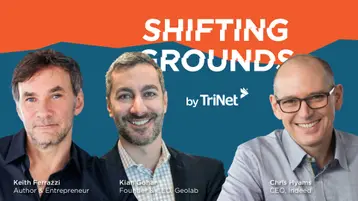
Keith Ferrazzi: Hi, I'm Keith Ferrazzi, the host of Shifting Grounds by TriNet. TriNet is a full-service HR solutions company committed to empowering small and medium-sized businesses by supporting their growth and enabling their people. You can catch our new episodes of Shifting Grounds on the third Tuesday of every month on Apple, Spotify and RISE.TriNet.com. All right, let's dive into it. I am so excited, because I have been having coffee and breakfast with this man now for pretty much every single day during the entire pandemic.
Chris Hyams is the CEO of Indeed, a platform that has made recruitment and finding a job easy and accessible. And the reason I say that, Chris, is I wake up to your morning ads with my coffee every single day, you are absolutely everywhere, my friend. I actually enjoy them. And I'm excited to finally get a chance to meet you personally. And I have an additional guest, who's not just a guest, he's a dear, dear old friend. He is my co-author of the most recent book "Competing in the New World of Work," and he's my business partner Kian Gohar. Kian would you please say hello, because I'm gonna ask you to play a particularly cohost role today just to try it on a slightly different format. So, Kian and Chris, hello, hello.
Chris Hyams: Good morning, everyone.
Kian Gohar: Hello.
Keith: So before we dive in, Chris, your background is incredibly interesting. I mean, you studied architecture at Princeton, you're the son of a screenwriter and cinematographer. Then you got into the film market research, marketing distribution industry where you're a founder there. I'm not gonna mention the fact that you went to that snooty-er of the Ivy schools, at Princeton. But Kian and I represent the other ones, Yale and Harvard. I would say just, you know, Chris, tell me a little bit about the navigation of it. You were so into the more creative artistic things, you know, at the beginning, but now all of a sudden with Indeed and careers, etc., how did the journey take you here?
Chris:
Yeah, certainly not a linear path. I started out, as you mentioned, studying architecture, as an undergrad. I found out very early on in that process that I had zero talent. And so that sort of cut out of the potential future career plans becoming an architect. I ended up getting a degree in history and theory of architecture, which is like an art history degree. You know, I normally say this, and people think that it's an over-exaggeration, but I lack what most people would think of as traditional ambition. Meaning I don't set big goals for myself and say, "This is where I wanna be in five years or 10 years," and set a course and head that way.
My chief ambition really evolved over time to wanna be useful and helpful to other people. I got out of school, realizing I wasn't gonna be an architect. My first job, I actually went to go work at an adolescent psychiatric hospital on the chemical dependency unit, working with young addicts and alcoholics. I then followed my then girlfriend, now wife to a small rural town in Vermont, with 3,000 people. She's from New York and I'm from LA, and we decided to get away from it all. And I taught special education in public high school in Vermont for a couple of years. I then followed Lizzy, my wife, out to Los Angeles where I had grown up. She was going to graduate school at UCLA. And I spent three years trying to become a professional musician. I'm a drummer and I've played for many, many years. And as I like to say, I tried to become a rock star and failed, but I had a great time trying.
And then really what happened was, like a lot of my life, and I have to acknowledge good fortune and privilege at sort of every step of the way. I was able to... Lizzy got a job at Rice University as an academic librarian. I could take undergraduate classes for free as the spouse of a staff member. And this was 1993, so this was before the World Wide Web as we know it sort of happened. And it was certainly before computer science was a cool or lucrative career path. It was fairly geeky. But kind of out of left field I got my first email account in 1990. I had a roommate from college who had moved to Indonesia, then Thailand, then Japan. And we were able to be in contact over, you know, the modem and that was this amazing thing in 1990.
And I got an account on if you're familiar with The WELL, which was what we would think of sort of as an early online community started by a bunch of the guys that ended up at EFF and Wired Magazine. And sort of this world was starting to open up but it was very much not mainstream. And so, I thought I'd give computer science a shot and really just flipped out for it immediately and said, “This is how my brain works. This is what I wanna do for the rest of my life."
Really, again, good fortune. Right place, right time. I ended up getting a master's in CS. I stayed at Rice for three years. I was there from '93 to '95. And during that time, the first release of Mosaic, which was the first widely available web browser, came out along with my boss Prentice Riddle, at the time, at the Information Systems Group at Rice, we installed what we believe was the first web server in the state of Texas, the first version of the Linux operating system, the first version of the Java programming language and the amazon.com all launched in that time that I was in graduate school.
So suddenly, the web as we know it happened, and I ended up then joining an Austin company as a software engineer. And then sort of through a series of events that were not driven by me wanting to take on more responsibility or opportunity, I went from writing code to essentially leading the engineering organization in a very short period of time. And a big part of that was because I was someone who had spent time dealing with people. And I understood technology. And it was that sort of combination of caring for humans and understanding technology that kind of led me down the path I'm on.
Keith: So we're gonna catch up with that path and where it is today. But what an amazingly interesting, winding road and, you know, just the idea, obviously, the intersection of music and technology and art is a very interesting intersection. I see it a lot actually, when I'm talking to individuals who have gone a little bit deep tech. I think you see things differently than the rest of us do, which is what this conversation is about today. The learning objective for the dialogue today, for those who are listening, is going to be that of the subject of foresight. And I couldn't imagine based on that background, we just heard from Chris, which I wasn't even fully aware of, you know, what does it mean for us as leaders and entrepreneurs to be able to look around corners and foresee the future and be able to find both risk and opportunity in it?
Chris, before we go on, and it's actually I mean, your background was very touching, I've got a very rich commitment to the foster care system personally. And you know, making sure that disadvantaged children are taken care of differently than the world is taking care of them today. But obviously, our audience here has already been drawn into loving on you. But I wanna take it one step further. Something I like to do at the beginning of a conversation I call it just an energy check. And so, I'm just gonna ask both you and Kian a simple question, I could answer it myself: what's bringing up your energy right now? And what's dialing down your energy right now? I do this. It's a purposeful empathy tool. I do this because when we're coaching executive teams, it's so often people dive right into the business at hand. And they forget the simple connection element that's so important to teams and effective, productive relationships.
So we're doing this for our audience to start loving on you even more. So what's dialing up our energy? What's bringing it down? What's dialing up my energy right now is my significant other and I just bought a house in San Francisco. So we'll be splitting our time between San Fran and Los Angeles, which I couldn't be more thrilled by. I love the vibe of my burner community up there and my entrepreneur community. So those two things combined will be a lot of fun to be steeping into.
What's dialing down my energy as I just got back and I'm about to go on another week of four-city visits a week. And that hadn't happened for several years and that was the norm in the past. And I'm just not sure I'm up for it anymore. It's not a physiological thing. It's an emotional thing. I did fall in love during the pandemic. So I've got something to stay here for. But it's bringing down my energy and I'm hearing it all the time and it sounds just overused. But it's dragging me down a bit and some questions of how I wanna live my life. Kian, why don't you go and then we'll end with Chris.
Kian: What's dialing up my energy is I've been in Silicon Valley for the last week where I've spent the better part of the last decade helping companies and executives learn about the future as a trained futurist. And I had a chance to reconnect with lots of old friends here at Singularity University and at Stanford, and elsewhere in the Valley. So it's been a week of reconnections after two years away from the Valley. So that's been amazing.
And the second thing that's bringing my energy down, Keith, is actually very similar to yours. I'll piggyback off of that and that I am on constant travel pretty much every week going forward for the next five weeks. And I don't have a human loved one but I do have a four-legged loved one. I have an 11-year-old dog, who is knock on wood, very healthy. But you know, he's older and I've been with him every single day for the last two years of the pandemic and being away for so long all of a sudden is disruptive and I do miss that a lot.
Keith: Chris, bring us home.
Chris: That's great. Well, congrats, Keith, on both the home and the falling in love. Those are both amazing things. You know, what's dialing up my energy right now, interestingly, I think it's a lot of simple things that being at home for the last couple of years of the pandemic and not traveling and running around, I've been doing a lot of reading and I've been doing a lot of cooking and spending time outdoors, time with friends. My wife, we're gonna be married 30 years in June, we have been living together for 32 years, she's been gone for the last couple of months in New York City finishing up a graduate degree. She's coming home in about an hour. So that's definitely dialing up my energy. I'm looking forward to that.
In terms of dialing down my energy, you know, one of the things that I try to do is the sort of... I don't know, emotional jujitsu of taking the things that drag me down and trying to turn that energy into some inspiration for change. And you know, what's on my mind right now, Indeed has a business called Indeed Flex, which is a part-time temporary staffing app, where workers can essentially get pre-qualified for certain types of roles and then they can search for a role, they can book a shift, work that shift to get paid, all by Indeed.
I, along with my SVP of operations, last weekend signed up and worked a shift at an event center here in Austin. It was a George Strait and Willie Nelson concert, worked security, had the blue shirt on, was waving the wands and confiscating people's vape pens and things on the way in. I spoke to 50 workers who I was working that shift with. And every single person I spoke to, this was a second, third, fourth or fifth job. The vast majority of them actually had full-time jobs. And so, it wasn't like they were stringing together, they just needed extra money to make ends meet. There were buses from San Antonio, Dallas and Houston, that took 20 and 30 people. So Dallas, for anyone that doesn't know, is a three-and-a-half-hour drive from Austin in no traffic. So there are people who got on a bus, drove three and a half hours worked an eight-hour shift from from 5 p.m. til after midnight and then took a three-and-a-half-hour bus back and half of them had done the same the day before.
And so, we're in this incredible tight labor market right now. And there are still people who are working multiple jobs just to make ends meet. So for us, at Indeed, that means, you know, our mission and our vision of trying to make it simple and fast to get a better job is turning that energy, which is a little bit sapping into some inspiration to action.
Keith: And obviously, that's a beautiful safety net and an opportunity that you're giving people but also just from the joyful work. I mean, the ability to give people gig economy variety, is just extraordinary for people to be able to tap in and out of earning and making a living as their life can suit it. I think that's fantastic. By the way, just what roles are you targeting for this type of work? And where do you see it going? Obviously, you know, we're now merging into a little bit of where your foresight is. And there's lots of platforms out there that have been very successful, like Upwork and others. Where do you see the job roles going for this kind of work for yourself?
Chris: Yeah, so our mission at Indeed is to help people get jobs. And that's all of the types of people, all the types of roles and all the types of work, that people could need. And so, we've historically focused on full-time employment. This is something new for us. What's different between what we're doing and what some of these other services are doing is that we're actually, we're an employer of record. So, we're a full-service staffing agency. These are not 1099 workers, which means that we're handling insurance and benefits, which we think is actually... and there's a big discussion about that right now in Silicon Valley with this whole gig economy. And I think it's really gonna be important for people to pay attention to really the opportunities and the benefits for workers. I think that a lot of these services right now are providing opportunity for people but without a safety net.
And that's something that we saw very clearly when the pandemic hit. And there were so many sectors that like hospitality, that were shut down immediately and millions of workers left without any type of recourse at all. And so that's gotten a lot of people rethinking where they fit. Indeed Flex today is primarily focused on hospitality and light industrial, but our vision is to expand to all types of opportunities.
Keith: Well, I wanna help our listeners separate two different things that I want our conversation to focus on. One of them, I'd like to get to the system of foresight, the system of looking around corners. And I'd love to hear a little bit about how that gets institutionalized in Indeed. In fact, we featured you in a chapter of the book that Kian and I wrote, but he did the primary lead, which is why I wanted him here. But then the second thing other than the system is just some of the foresight that you do see. And there's a great model that we introduced in the book called Steep—you know, just looking at the world sociologically.
You know, societal changes, consumer demands, etc, technologically and the technological disruptions and what the opportunity is there, economic, business cycles, labor markets, consumer confidence, environmental. That's everything from supply chain concerns, all the way to availability of natural resources and political—government regulations there of course, in the world right now it's becoming quite upended and interesting.
So let's actually go back to the systematic component. When as the CEO of Indeed, how do you make sure that your organization is actively assessing risk and opportunities? What's the system look like for you? And maybe if you wanna do that and at the same time, perhaps give an example of how that comes to life?
Chris: Sure. One of the things that actually Kian and I talked about that made its way into that chapter of the book, and again, thank you so much for inviting us to be a part of that. Indeed has been around since 2004. We were acquired in 2012, by a Japanese company called Recruit Holdings, which is now better known in the U.S. At the time, it was pretty much unknown in the U.S., but it's a company that has been around for 60 years and we have had this amazing benefit of being a, you know, relatively younger Western technology company, that is now part of a company that's been around for decades and thinks in terms of decades—which means that we think in terms of things like economic cycles. Anyone, you know, that has been in the business world for a couple of decades knows that they roll around every seven to 10 years.
We started doing regular scenario planning, probably four years ago and preparing for the next economic downturn. Obviously, nobody knew it was gonna look like a global pandemic on top of that. But we get together as an executive team, every single quarter. We spend three days together and we're a geographically distributed leadership team. And so part of this is team building and connections. But a big part of it is to pick our heads up out of the details of quotas and revenue this week, this month, and to take a look at the longer term.
And so, for example, we have done multiple scenarios where we looked at different potential economic downturns, how we would respond and really had a playbook. So when March of 2020, rolled around, we didn't have to lock ourselves in a war room and spend weeks trying to fit. We knew exactly what we needed to do to get our variable expenses in order, where we were gonna continue to invest and support our employees. And really, within a week or so turned our attention entirely to how we were gonna help these 22 million Americans who had lost jobs in about six weeks.
And then all the people around the world but then all of our clients, the ones who were both no longer trying to hire, but then suddenly in these industries which overnight things like grocery stores needed to become etailers and had none of the infrastructure and none of the people they needed to staff up in ways they've never had before. So, we were able to turn our focus to how can we be useful in the current climate and not have to spend several months just figuring out how to get our finances in order.
Keith: Interesting. And that all came at that interface of your mission and your purpose at the core of that, right?
Chris: Absolutely. So I mean, we exist… our mission is to help people get jobs as I say to the company every single week. This is what gets us out of bed in the morning and what keeps us going all day long. And it really is the thing that drives every aspect of our business. And so we went into this challenge that was ahead of us that we were in an incredibly fortunate situation where we didn't have to sit around and worry about how we were gonna survive economically. We looked at how we could be useful in this moment.
And that mission to help people get jobs was more vital in the start of 2020 than it had ever been before. And it had been the driving force in the lifeblood of the company before that. And so, we set to work, and some of this is outlined in the book, I don't have to tell the whole story again, unless we wanna go into it. But we were able to help millions of job seekers get work. We were really able to help thousands of employers who were trying to hire in areas and at a scale that they had never done before. And that allowed us to actually learn so much more that, you know, crisis is a time when old thinking and biases that people have tend to go out the window because of necessity. And it allowed us to become a different type of partner and to learn along with our customers and really accelerate a set of things that we have been working on for a long time that we thought might take another decade to come around and really have come to pass in the last year-and-a-half to two years.
Keith: I'm gonna ask Kian to dive in a second. But before we go there, I want to tie a bow. One of the things we try to do on this podcast is be as practical as possible for the listener to take things away. And the big thing that I take away from what you said is: You had this all planned; you had scenario planning in place. And you were ready to be able to adjust to an economic downturn that you didn't know that it was gonna come from a pandemic, but the planning process had been in place so that you were prepared. So we had a book, you had a playbook, which is exciting.
Chris: Exactly. And we've done the same kinds of things with competition. We just did actually our most recent one, we got the entire executive team together in February and came up with a case study where some very, very large and powerful company ends up making a significant number of acquisitions and decides to go after our market. And how do we respond to that? And got the entire executive team thinking about that. We've been doing things like that for several years. And so, when competition pops up from big and small companies, we at least have thought through and have the muscle memory around how to respond to issues like that.
And that has helped us to be able to, I guess, you know, the phrase is respond instead of react and to be able to pull a playbook out. We do this, I think lots of other companies do the same around security. So we do tabletop exercises around various types of security breaches so we understand what are the paths of communication. How do you pre-draft all of the things that you might need to go out to the public or to the company in advance so you're not sitting around wordsmithing things in the middle of an emergency? And how do you actually get in place and know who's supposed to be doing what and when? Those things have made a measurable difference in how we respond to things.
Kian: I'd love to get a little tactical, Chris, for our listeners who really are intrigued by this idea of scenario planning and foresight and very impressed by what you guys have done on a consistent basis. If you can help us learn in broad strokes, what are the kinds of questions that your team asks in these foresight exercises that would be useful, not specifically, directly relevant to Indeed, but rather a listener who is a small, medium-size entrepreneur or CEO who can take the same kind of thinking and apply it to their business? So what are the types of questions that you pose in your quarterly leadership off-sites around scenario planning? And in which categories are they so that our listeners can kind of really emulate the best from the best like you guys?
Chris: Yeah, so I can, without getting specific around the competition itself, I can actually just use this as the most recent example. Our February off-site came up with the scenario of a very large company entering our space with a huge amount of resources. And what we actually did is we split the executive team into two different groups. And one of the groups got one scenario and the other group got another scenario. It was actually they then split into much smaller groups of four to five people, basically.
One of the groups got a scenario where they were hired by this company as the new head of job search. And their goal was to compete against Indeed. And so, they had essentially an unlimited budget and resources and they needed to put together their plan. What were the specific KPIs that they would measure to guarantee that they were on track to taking over Indeed's business? And specifically, what was their go to market strategy? How are they gonna acquire job seekers? And how are they gonna acquire customers and take them away from Indeed? And that they had two weeks before the board and they had to present to the board of this company.
The other team got a scenario where, because I failed to recognize this threat, the board fired me, "You are the new CEO of Indeed and you have to present to the board of Indeed in one year how you're going to maintain our leadership and grow our market share in the face of this competition, as well as retain our key talent and our key customers." And so, we had those groups get together and they discussed in smaller groups. Keith, I was actually listening to a recent podcast of yours, where you were talking about the difference between bringing small groups of people together and the types of ideas, and the way to elevate voices that we've been doing that with this type of scenario planning for the last decade. And you get a set of ideas that come up that certainly would never come up if we had the entire 50 people in a room debating or discussing, or if it was just me trying to come up with the idea. I mean, we get much better ideas this way.
Keith: And Chris, one of the things that we determined during hybrid work is you can actually start with 50 people in the room and give the briefing, snap your fingers and send everybody to small breakout rooms where there's much more psychological safety and creativity and innovation and risk taking in that small group, have them open a Google doc, spend, what, half an hour or even 45 minutes, whatever, in that small group and then come back. So we were helping to coach and facilitate this at some of the largest organizations like Unilever and Federal Express with thousands of employees during their business planning cycle, during town halls.
So people don't recognize the power of the small group. It's such a powerful medium. And so, there's two ways to do it. You can actually convene a small group, but you can also start with a larger group with the energy of that and the democracy of it, and then just go to a small group—which is a beautiful opportunity. Did you do this physically? Or did you do it in a remote setting?
Chris: So this was our first time with the whole leadership team together in two years. So, we've been doing this quarterly for over a decade. We did eight quarterly offsites over Zoom, did it the same way and in Zoom breakout rooms. And this was really the first time bringing that whole group together. It was really powerful. But so we just ended up using a bunch of rooms and splitting people up. And then we essentially did it bracket style. We would have everyone come back and present to smaller groups and they would pick the presentation they liked the best and then they would bring it back.
And then we brought the entire team together to have representatives from four of the teams that had the strongest ideas to present and to do a Q&A as a group. And then we debrief and come away with, okay, if this is a scenario that might happen, the important piece is once you do all that to then say, "Okay, so what is our strategy now?” Because it might not be exactly this, but something like this is gonna happen. And so if we believe that, in the face of some type of challenge from the outside, we might do X, Y and Z, let's just start doing that today.
Keith: So I like this big rock scenario planning. And you'd use the model of steep, you know, what are the changes, you did an economic one first with business cycles, you did a competitive one. And we could go down the list and imagine all of the potential disruptions that could occur or opportunities that could occur. And you can schedule those over a period of year and I think it's a beautiful system.
What I wanted to add was the example that complimented yours in the chapter was, when on a monthly basis, an executive team assigns to individual executive team members a vantage point of looking at the world, so somebody's got the economic risk and opportunity vantage, someone's got the competitive, someone's got the sociological, somebody's got the customer, somebody's got the etc. And then you just pause for five minutes, once a month, and say, from each of your vantage points, "Is there a scenario planning exercise that we should be running around something that you see?"
So in a sense, it helps to source what those scenarios are so that you can have that as a standing agenda item and it's not just up to you, Chris, to say, "We're gonna do one on this topic and we're gonna wanna do one on this topic," but we could constantly and iteratively source where those are coming from.
Kian: I was actually gonna jump in on that exact point. I'm curious, Chris, how do the topics for your quarterly scenario planning exercises come to fruition? Who decides what they are?
Chris: That's a great question. That started out back in 2012, when we were acquired by Recruit. The current CEO of Recruit, my boss, Hisayuki Idekoba known as Deko, he came and became the CEO of Indeed and he introduced this. And so for the first few years, he was coming up with the scenarios. He then asked me and our then chief operating officer to start taking over this. And so, this was really part of his succession planning and training of us was getting us to start to think about what are the big shifts, trends, you know, future areas we need to prepare for and how do we lead the leadership team through those changes?
We have used these off-sites as a way to give more opportunity to other senior leaders. So I've had different senior leaders actually be the facilitators or manage these sessions over time. It used to be that I did everything. But I still am right now. For the last couple years, I have been designing the scenarios myself, I think it's actually one of the more important parts of my job is one of the big things that people should be thinking about for the future. But it is an area where getting more members of the leadership team to bring their own ideas and to help with the design of these is, I think, an amazing opportunity.
And this is an area where, you know, look, a lot of companies of our size and maturity are not as good with succession planning as we should be. That is an area that I have a tremendous amount of respect for Recruit. The company has been around for 62 years now. And Japanese companies tend to think very carefully about this. Recruit has been sort of a masterclass for us. And that's a big area of focus for me. We just have a new chief people officer who will be starting next month. I'm not ready to announce it yet, but I'm very excited about that. And that's one of the primary topics that we're gonna be focused on is succession planning at every level of the organization.
Keith: I'd like to look a little bit around the corner, if you don't mind. You've already, you found this market. And you obviously had probably foreseen this market prior to the pandemic and looked at, as you said, but this allowed you to radically accelerate your entry into this market. What are some of the other big changes? You mentioned, what was going on in California around the societal and government regulations around gig work, the societal move into gig work with the government regulations and some of the battle around that. What are some of the other things that you see, if you put your crystal ball up, that you're thinking about that could be potential scenario planning exercises for the future?
Chris: Yeah, one of the biggest things that is not new, but has more attention on it than I think it has in the past, is just the bias and barriers and lack of equity, in the employment world. And you see this clearly in every aspect of society, from the criminal justice system to housing, education and health care, but employee is really foundational for that. And, you know, as I like to sort of describe it, we have a front row seat to the global economy. One of the things that we see very clearly is that talent is universal. Opportunity is not. And bias and barriers in the hiring process are really the primary and chief motivation for Indeed to really focus on our own diversity, equity and inclusion. But really trying to build products that provide more inclusive and equitable hiring.
We have a big team now focused on ethics of AI and bias and algorithms. This is a very hot topic right now. It's the intersection of what's going on from, again, nothing new in the world, but a new awareness and kind of awakening. I think about the differences between the experience of black and brown and white Americans, and the wage gap between men and women, and the growing gap between the rich and the poor in this country. And you know, a lot of conversations around the future of work are entirely fixated on hybrid work and remote work and all the things that the three of us get to live in.
But at Indeed, you know, it's the global economy and the vast majority of workers do not have the option to work remotely. And we saw at the start of the pandemic, just the unbelievable widening gap there. And so I think it's one of those things that is creating a new movement in terms of awareness and activism, and our focus is how can we use our data and technology to measure, create clarity and then make improvements in these areas. And I think that that's something that, you know, when you look at potential good that can come out of horrible things that the pandemic itself was, you know, it was awful and unimaginable. But it did create an environment that shined a light on a set of these issues that I think many people have just been comfortable to ignore for a very, very long time. And we're hoping to be able to carry that awareness and that enthusiasm to really driving real change.
Keith: A dear friend of mine passed away during the pandemic. His name was Tony Hsieh from Zappos. He was a great friend and a business partner. And what I loved about Tony and what he contributed to the world was a radical way of thinking about human capital, just really the elevation of humans in the workplace. And so, we created a foundation, The Tony Hsieh Award for entrepreneurs who were not only disrupting their business models but disrupting human capital models.
What are some of the things that you see inside of organizations shifting and changing? And what are some of the more... and by the way, I would highly, you know, if you wanna get involved in what we're doing, we're crowdsourcing innovations from thousands of entrepreneurs who are raising their hand saying, "I'm doing a really cool practice for and with my people." But if you look at inside the company, what are some of the things you're excited about, or maybe Indeed is doing, or you're thinking about doing?
Chris: Yeah, so we're very focused and committed to this work of equity and inclusion within the business because we think it's fundamental to how we can actually show up and try to solve these problems in the outside world. And where we've landed with this, you know, we started Indeed like a lot of other companies. The company was founded in 2004. I was hired in 2010 as the head of product. I was the ninth member of the senior leadership team and the ninth middle-aged white guy. Eight of us were married with kids. So basically, zero diversity. It wasn't part of the fabric of the business at the time.
And as we've grown and been, really with sincerity, trying to do this work, probably for the last six years or so, we've come to the point where our realization is that none of that work is possible as a bolt-on, as an afterthought, as a report that you run once a quarter. We are looking right now at essentially tearing our entire HR process down to the studs and rebuilding it from the ground up with equity as a lens. And that's a radical shift. And there's a lot more companies that are talking about it.
And the interesting thing is that you see smaller companies that are way out ahead of us and a whole host of other people, because they don't have the legacy of the systems and the institutions that had been a part of business. And we're seeing that show up. So you know, where it can be transformational in terms of talents, so I don't have to go through I think everyone's read the McKinsey and the Harvard Business Review studies around the value of diverse teams in terms of customer orientation and innovation and all of those things.
The trick is, people can read those reports and say, "This sounds great," and then have no ability to actually transform their own business because there is so much staying power in these very, very old institutions and it's not enough. So for us, thinking about how to actually rebuild our own systems and then how do we use that to transform our products to help everyone else to be able to hire and especially when you have an environment like today with the tightest labor market that we've seen in decades.
Anyone who's not really enthusiastic about trying to open up to new techniques to look at different filters and to start looking in different pools of talent that they've been looking at before, they're just gonna really lose from a competitive perspective because there's so much untapped opportunity out there. And that, to me, I think is going to be the biggest transformation of the next decade and in terms of how human capital can be deployed.
Kian: That's beautiful. Thanks for sharing that, Chris. And I think I'd love to maybe offer an additional scenario for you to consider long-term within the next decade along this issue of equity and inclusion. We've seen over the last 30, 40 years a globalization of manufacturing. And where manufacturing has left high-cost countries and gone to low-cost countries in terms of labor. And we've seen sort of a bottom amount of manufacturing jobs here in America.
Now, you know, there might be some forces over the last couple of years, which have slots that slowed that trend, or maybe even brought it back on shore a little bit for critical industries and healthcare. But we've seen this globalization of manufacturing jobs for the last 30 years. I think the pandemic has allowed us to think about working differently and where we might ordinarily hire back-office worker, accounting worker or marketing work here in the U.S. or wherever, in the high-cost economy. These digital tools like Zoom and all the various things that have come about as a result of the pandemic over the last two years of work from home, I think are offering a major opportunity for the globalization of service jobs to be potentially offshored to places that are lower cost.
And, you know, right now we are in a very tight labor market. But I see the signs right now of this offshoring and outsourcing of service, back-end jobs as well, that the economies or the economists aren't really talking about, because we're so concerned about inflation and so we're concerned about return to office. But I'd like to offer this as a scenario, which I think is actually quite likely, in the next 10 years, where we have a much more distributed workforce for service jobs that are typically done in back office, in whether it's marketing or accounting, etc. And I'd love to explore, you know, what that means for the American economy. Fast forward 10 years, what would that means for job search? What would that mean for the average individual? So, I'd love to just kind of hear your thoughts on that offer that as a scenario that might be worth exploring at some point in the future?
Chris: Yeah, no, I think it's a great question. And it's, you know, it's interesting, because all of these discussions, Thomas Friedman wrote, "The World Is Flat," I think it was 1999 and predicted all of these things were gonna happen and that totally didn't happen. And that suddenly, everyone was gonna be able to work everywhere. And you could be a software developer in, you know, Jackson Hole. And instead, what we saw for a couple decades was more and more people moving to San Francisco, more and more people moving to Seattle. And now it is possible, I think that some of those things might come to pass and that we're a couple of decades off from that. And between globalization and automation, you know, the two big things that sort of feel existential.
We have a point of view on that. And I think if you look at history, what happens with technology advances is that there is massive disruption, and then ultimately, the success and the profits that are generated by businesses allow them to invest more and to grow. And so like, one simple question that, you know, that we ask is that if automation is gonna long-term kill jobs. Why does Amazon employ a million people? They are the most obsessed with automation and AI business at scale. And they keep creating more and more work for people. And I think that, you can look at these things through the lens of long-term, there's gonna... our strong belief is that, you know, we're not gonna be facing long-term structural unemployment and that people are gonna sit around with nothing to do and that universal basic income is the only solution to these problems.
But we also think very, very clearly about the fact that these disruptive cycles have real impact on human beings, the people who are stuck in the middle of it, when automated driving technology and regulation reach a point together. Where we really can have trucks delivering things across the country without human beings, there's gonna be four and a half million people out of work very, very quickly. That's very real.
And so the long-term direction that humanity is gonna be okay also has these tightening cycles that the technological disruptions and innovations keep getting from multiple generations down to single generations now to multiple times within a generation potentially. And so, what our belief is is that the ability to understand in real-time what is happening when jobs are shrinking or when jobs are growing in different sectors and for Indeed's mission, which is to, you know, our vision is to make getting a job as simple and fast as pushing a button. We really, it's not hyperbole, it's not science fiction, we want to get to the point where everyone we're doing that with the shifts, right now that I worked, I pushed the button and worked a shift and got paid.
We believe that we can get there with full-time work as well. And that when entire industries are disrupted, as simply and quickly as possible, we wanna be able to redeploy people based on transferable skills and to help them land in the best place possible.
Keith: That was one of the things that Tony was really on to toward the end, which was very clear and definable skills badging for transferability of jobs. And I could easily see that coming to life in the situation that you're discussing. We have the same last question for everybody. And I'd be interested in hearing this, whether this is personally and professionally you mentioned, is Elizabeth, Lizzy, is that her nickname?
Chris: Yeah.
Keith: Okay, Lizzy got it. So you and Lizzy, whether it's personal or professional, what's making you really the most excited right now for your future?
Chris: Well, let me take a professional one, which is that, you know, we've spent a lot of time in the last couple of years, with, I think compassion in the workplace suddenly being something that was unavoidable. And you know, the way that I put it is that before the pandemic, if you asked the average American worker on their way into the office, "How are you doing?" the answer was always either "fine" or "great." I will point out that around the world, if you ask a German how they're doing, you normally get an honest answer. But what happened suddenly, in the spring of 2020 was you asked that question and you got a real answer.
And we have, you know, right now, I'm looking at, you know, your office and your home. We have these literal windows into people's lives, where you see, you know, piles of dirty laundry and screaming kids. And my dog in the middle of an all-hands, you know, threw up on the floor in my office. And these things happen. And we have had to then also with everything going on in the world, with xenophobia and Black Lives Matter, and all, like actually understand that people are complex organisms that bring a whole bunch of stuff into this eight-hour day with them—that my real hope for the future is that as we start coming back into an office, that we start seeing each other as whole human beings and that we ask, "How are you doing?" and wanna hear an honest answer. And that we don't just sort of pretend that none of this ever happened and go back to the way things were. I think that our hearts all cracked open, in some fundamental way that I hope they stay open.
Keith: Well, and a wonderful way to do that is that simple practice that we did at the beginning of this at the beginning of meetings—just ask everybody quickly to go around what's dialing your energy up, what's dialing your energy down? The ability to predictably have practices around empathy and compassion is just such a simple team activity that too many organizations forget. So it's a great way to tether that.
By the way, The Wall Street Journal is doing a great piece on the importance of empathy in the workplace going forward. I may, if you're interested, put you in touch with the writer there.
Chris: Yeah, great.
Keith: Well, look thanks, Chris and Kian, for joining us today and for this amazing journey. I've never gone this long before and I feel like I could go for another hour and that we could do that over a glass wine sometime. But thank you very much and just by way of signing out, our podcast Shifting Grounds by TriNet, thank you very much for attending. It's committed to helping real small businesses and their leaders with timely and relevant business content. Shifting Grounds drops the third Tuesday of every month and we hope you'll continue catching all our new episodes on Apple, Spotify and RISE.TriNet.com. Chris, Kian what a pleasure.


