The Potential of Mental Well-being
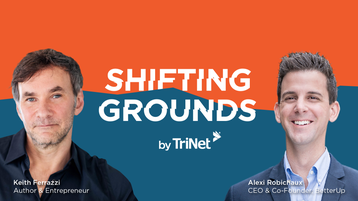
Keith Ferrazzi: Hi, there. I'm Keith Ferrazzi, the host of Shifting Grounds, by TriNet. TriNet is a full-service HR solutions company committed to empowering small and medium sized businesses by supporting their growth and enabling their people. You can catch our new episodes of Shifting Grounds on the third Tuesday of every month, on Apple, Spotify and Rise.TriNet.com.
Today, I have a particular pleasure in introducing somebody who I have not only a great deal of respect for, but also somebody who I have a great deal of affinity for. Alexi Robichaux is the CEO and co-founder of BetterUp. Now, I'll tell you why you're in for a treat. First of all, this is a guy who has a shared passion with many of us here for the human elevation in the workplace and has now developed a platform to bring that to the world at scale. Now, Alexi founded BetterUp in 2013 to provide lasting behavior change and addressing mental health through personalized video coaching, which leverages really advanced technologies that we're going to be talking about today, like, AI and others, alongside the augmentation of human coaches.
Now, many of you may have seen some of the big news, not only their business success and their fundraising, but also the attraction of some extraordinary luminaries like Prince Harry, Duke of Sussex, who's BetterUp's chief impact officer. Maybe we can ask a little bit about that. Now, in October, I understand, of 2021, BetterUp crossed a milestone of over 1 million coaching sessions completed. Now, Alexi's background, we're gonna get into that in a little bit, relative to what were some of his experiences that led him to develop this platform. But let me share with you what I hope for our listeners or our learning objectives for today. Number one, mental health is so critical for us as leaders. And I want to talk about how critical that is, the awakening and the awareness of it, and what Alexi's organization brings to the table. Second thing is I want to talk a little bit about this idea of individuals exploring an organization. Alexi and I have actually been talking about this a lot. And we call it the great exploration that's going on in organizations today. And how do we as leaders meet that great exploration?
And then finally, once again, this is an article that I'm co-creating with Alexi and some of his team around the subject of burnout. How do leaders navigate burnout? And we've just gone through one of the most tumultuous times you can possibly imagine only to end up in some of the tumultuous times that you've ever imagined. And with that in mind, we've only really talked about what our response is. So hopefully with that, we're all strapped in and excited and ready. And I want to welcome my friend Alexi. But before I do, Alexi, congratulations on the new baby. My opening question to you is going to be, what have you discovered as a new father?
Alexi Robichaux: Well, first of all, thank you, Keith, for having me. And right back at you. That was a very kind intro. And I'm excited to be here. And I have a ton of affection and admiration for what you do and you as well. So, it's really exciting to have the conversation.
Yes, new father; I've learned a ton. I mean, I guess I'll say the first thing is that you learn that sleeping like a baby is a bit of a misnomer. But I think at a high level, it's been most rewarding journey of my life. And it's been really cool just to see how fast little humans grow and learn. And they are just constantly in learning mode, mimicking, picking up, interacting with their environment. And it's actually really refreshing on how sometimes we feel like at my age, learning is this big, ominous thing, like a burden I have to do. But you just realize, learning is the zest of life. That actually should be our natural mode. That should be how we approach the world, is wonderment, fascination. So, it's been, on so many different levels, really rewarding. But I think in the context of today, that's been one of the big insights for me.
Keith: You know, I'm interested, there was a time in your life when you were a tech leader, executive and you experienced a workplace and a way of working that you didn't find acceptable. How much did that influence what you ultimately did in the creation of BetterUp? And maybe you can tell a little bit of that journey.
Alexi: Yeah. I think for me, it was kind of like a coming home moment, so to speak. So, I had been really fortunate to fall in with a group of friends in high school where we were doing after school coaching for our peers, in a peer-to-peer coaching model on leadership and life skills. Which for us was like 16, we were reading Napoleon Hill, Steve Covey, Kenneth Blanchard, kind of like these masters, so to speak, of the intersection of self-improvement and leadership. And that was my weekend. That was my afternoons. That was my passion project where I spent my time, as did Eddie, my co-founder. And in my career, I was fortunate enough to find my way to Silicon Valley, fortunate enough to go through a successful acquisition by a large company, fortunate enough to become a very young executive at that company.
And as I went through that process of really burning myself out, I think what it caused is me to hit pause and really evaluate, which is what coaching does. It was like a meta coaching moment. It caused me to evaluate my values. And I asked myself, "Hey, what really gives me energy? What really makes me feel alive? Where do I really feel like I'm achieving my purpose? And is that aligned with this job or this role I am?" And for me, that was the coming at home process.
I realized, look, if I just am objective here, I am most energized, I am most alive when I'm coaching and mentoring these high school students. And so, that became, I think, the silver thread that led to BetterUp. And obviously, I wasn't in high school anymore, so the natural thing was, like, well, how would I do this for myself and my friends today? We were young professionals. And to cut a long story short, that was the start of BetterUp. But it started with that values inventory, as we'd say in coaching, and really doing some hard soul searching and asking myself, I'm not living in alignment with those values.
Keith: So, BetterUp focuses on both mental health, but general productivity and the awakening of individuals in the workplace for their growth. I want to focus on the mental health for a moment. I read something that you had written in the Financial Times where you called the pandemic the dot-com boom for mental health. And I thought maybe you could riff on that a bit. Was it really an awakening? And more importantly, have we been able to sustain it?
Alexi: Yeah. I mean, look, I think the long answer is, I hope that statement proves to be right. I hope so. Time will tell. But I think the signs are very positive. So, I think part of this is, what do we mean by mental health? Historically, what we've meant culturally, by the term mental health, is what one of our BetterUp researchers and science board member, Martin Seligman, who's the pioneer of positive psychology and former president of the APA, would say is actually, we mean mental illness in Western culture. When we say mental health, what we really mean is the removal of mental illness. Now, when we say physical health, we don't necessarily think of the removal of illness, we have a concept of healthfulness, being healthy. So we think of going to the gym, taking our vitamins...
Keith: And a sense of well-being.
Alexi: Well-being, vigor, right? We have a sense of that. But in mental health, we're behind. And there's a huge intellectual history of why that's the case. There has been, in the development of psychology, a golden braid, so to speak, of folks focused on human potential from Maslow, Csikszentmihalyi, I'm gonna butcher his name, at Claremont, to Marty, you know, to folks in existential psychotherapy. So there's always been this, like, humanistic side. Viktor Frankl, right? But in general, most people's understanding of mental health is the removal of mental illness. And so, when we make that statement about the boom, what we're really talking about, and I do think this has happened, is for the first time in, you know 100-plus years, there being a collective awakening and a change in the zeitgeist or the consciousness where people are starting to realize, mental health is not just me not being mentally unhealthy. It's actually me investing in my mental fitness, wellbeing, these preventative skills. And that is a huge paradigm shift. That is an enormous shift.
Keith: Now, the choice to activate on that is also a paradigm shift. I don't know that leaders in a situation of high productivity, high challenge, market competitiveness, volatility. And we really hit a wall during the pandemic, where even the most stalwart leaders were seeing themselves crumble, therefore, they created empathy, therefore, they started to come up with some interventions. As we're moving into a softening economy, for those of you potentially listening to this in the future, we're right now, at the beginning of what some people say may be a recessionary period of time. And once again, there's a lot of stress and a lot of mental un-wellbeing that is existing. My question, Alexi, to the leaders listening to this, what can they do, not only to awaken, but then to begin to activate?
Alexi: Yeah, great question. So I think part of it... and, you know, this is kind of my orientation of BetterUp, is it starts with us as leaders. And we have to do some work. And I think one thing just to name it, that I don't think gets enough intention is, as a leader, latently, most of the models of management and the models of productivity that I will implicitly pick up, are carryovers, if we're being honest, from a world where the unit of production was the human body. And productivity, at a very latent level is still, like, a time study of factory workers. Even when we say productivity, we really think about, like, how much production is this person doing? But we need to elevate our thinking and evolve our thinking to the reality that is the economy today—that for most people, even if they're in a factory, they're a knowledge worker. And the actual unit and means of productions today is not the human body, it's bound by the human body. It's actually the human mind and its creativity.
And so, just like employers used to provide health insurance because they realized when people were sick, productivity on factory lines went down, we have to rethink and say, hey, performance and productivity is not separate from the mental health of my workforce, because the unit of productivity is actually their mind. So, if my folks are hurting in their minds, they're hurting in their hearts, they're hurting in their soul. My output, creative insights, data-driven insights, these are all psychological outputs. If my psychology is off in my workforce, I will have impaired productivity. And I think as leaders, we have to just sit with that for a second and ask, how do we philosophically record productivity? How do we even think about measuring it? The reality is, in a creative economy, it's a set of punctuated S-curves to create value. It's not linear. It is not like factory work. There are these moments that are asymmetric, there are these breakthroughs. And when you're in that pursuit, people's resilience, their ability to adapt to change, the gas they have in their tank, psychologically speaking, is where you should be focused as a leader.
So my biggest message to your question would be, we need to stop thinking of performance and wellbeing as two separate pursuits and realize that in a creative economy, that is a knowledge economy, that is a psychologically-generated economy, they are the exact same thing. If I am mentally hurting, then I am not going to be producing. And I can get into... I mean, we have so much data on this from those million coaching sessions on the strong correlation between people's resilience, their ability to create, their ability to do production, tied to their ability to how they can think in these skills.
Keith: I want to bring in another key word, you talked about performance, you talked about productivity. But I read a quote from you that talked about the paradigm shift that we've just gone through of a true awakening of human potential. And I feel like what you're looking at and what you're talking about is not just looking at individual productivity and performance, but looking at the maximization of potential. And that, of course, is grounded in so many other things, so much more richer form of leadership than to just focus on grinding out the performance of an individual. Does that seem to align to what you're saying?
Alexi: Yeah. And I can take 0.0 credit for that. This is, like, it's been staring us in the face. I think we just don't do it well. This is literally... You know, Abraham Maslow famously spent the last years of his life studying workers in a factory in Menlo Park. And he has this famous portion where he basically says, "I have given up on therapy as a scalable way to change the world, because management done well for the masses achieves the same outcomes as therapy for most people." Like, just sit with that for a second.
Keith: I love that, because that's why I'm in the business that I'm in. I believe that if you transform teams, you transform the world. If you transform teams, you transform relationships.
Alexi: That’s right.
Keith: Candor, transparency, intimacy.
Alexi: Marriages, home systems, family systems, yeah.
Keith: And as a result, it cascades out into the world. The article that I read, where you were talking about the awakening of human potential, I thought it'd be useful to some of our listeners to go over some of the points. You know, you pointed out that every manager matters, right? I love that comment and the importance of that and the individual human potential. And as you know, one of my dearest friends, Tony Hsieh, who passed away tragically during the pandemic, he fundamentally believed that. But then you went on to talk about how continuous learning is the new competitive advantage. And I think that's important for leaders to hear a little bit from you about. And we're gonna get into the mental wellbeing component and burnout in a second in detail. But talk about continuous learning and how, for instance you, as a leader, bring continuous learning into your team environment.
Alexi: Great. Yeah. So, I mean, look, generally, we believe in, you know, informed by science and research, we believe in CBT-informed action model of human life, which is basically our thoughts shape our behaviors. So when we're talking about getting a team to perform better, the adage, Eddie, my co-founder and I, have generally adopted and believe in is, teams that think together lead together. The actual job within the job to get done is to get people to think together and to align their minds. And learning together in a shared way is one of the best ways to do this. I love this quote from Leonardo da Vinci, "Learning never exhausts the mind." And he lived that as a life, right? If you want to energize your people in an economic downturn, get them learning, right? Learning is this super energizing thing we do. We just talked about this in my son, Noah. It is truly the zest of life and we see this in children.
Okay, so how do we do this? And I don't know that we're perfect here, but a couple techniques that we've used, we've seen some success with, is, if you are an executive at BetterUp, you do not go to an off-site, you do not go to a major summit, you do not go to a major meeting that does not start with a freshman seminar reader and primer. And we spend two hours every morning with our senior leaders, every time we get together. We waste time together for two hours reading a chapter of Andy Grove, reading a chapter of Maslow, reading Brené Brown, and having a discussion about how do these concepts relate to our life. And what you find is, what you do in that moment is so telling in what you communicate. You just communicated as executives, that your job is not productivity. That's the downstream output of your job. Your job is actually being a curious human being who is learning about themselves and learning about their business.
And what you find is, productivity increases, alignment increases. And you, as a senior leader, you get to listen to your people and you actually get to understand where's their thinking ahead of the curve, maybe where they're thinking needs a little coaching, maybe where the head of marketing's thinking isn't aligned to the head of sales or vice versa. So it's actually a really insightful, but most importantly, it's a humanizing thing that says, we're not here as cogs in a machine. We're actually here as students of life and the business together. And let's learn together.
Keith: Now, how do you address sometimes, the ambivalence of change and the ambivalence toward moving off of the momentum of the historical? Because so many leaders, I'm sure are listening to this and they're thinking, “Holy cow, this is a deviation from the way our people think, and frankly, the way we've been leading.” How do you begin to address that?
Alexi: Yeah. I mean, reflecting on my experience, I often say, I mean, do our people think? Yes. But, like, if we're being honest, as senior leaders, I ask myself, how much do we make it their job, and we expect them to think, right? Versus thinking is actually something you may have to do to do the job I expect you to do, versus, hey, this is like “Fifth Discipline” Peter Senge 101, is thinking the job, is learning the business, the job. So one simple thing to your question is, you know, I started doing this. I wish I had done it earlier. But in my performance feedback, in my performance reviews for C level folks at BetterUp now, there's a whole section on mindsets. What is their critical thinking on a four-point scale? We took this from a great HBR article. How do we rate them? What are the insights they're cascading up in the business, right? And so, a lot of this is about, this is your job as a senior leader. It's not to manage the day to day, it's to manage the future. And to be thinking about, how do we disrupt ourselves? Where's the market going? Where's the economy going? What kind of talent do we need? And so, the basics are true, inspect what you expect. But part of it I think, as a senior leader, is really ask, what do I think this person's job is? Is it to think ahead of the business? Great, then align your compensation around that. Align your performance management around that. Be very explicit around that. And set that tone at the top by being an avid learner yourself.
Keith: We've been talking about learning cultures for decades. And it sounds to me like you've really tried to turn that into practice in BetterUp. My recommendation is, you need to write more about that in terms of your own internal cultures. And I'd even point you and other listeners to the Tony Hsieh Award. I think you've got something truly unique there, not only in your solution to clients, which we'll get to some of that in a moment, but also in how you think about building a learning culture in BetterUp. So I'd love to see somebody in your organization even apply for the Tony Award. I think he'd be proud of what you're doing.
Alexi: Oh, well, that's very flattering of you. And we will certainly follow up on that.
Keith: Let me pivot for a second and talk about the great exploration and where people are showing up today. You were quoted in an article that I wrote in Harvard Business Review. But it's so important to recognize that people came out of the pandemic and were on their heels, questioning fundamentals. Right? I would like to talk a little bit about how do your coaches help their clients? And how do you think, even inside of BetterUp, to provide a space for our associates to explore while they're here and not feel that they have to exit to explore what's the meaning of work and where they should be today?
Alexi: Great. Yeah, this is huge. And I love the way you frame this, Keith, is it's an exploration, right? There's this, it wasn't driven by an existential thing, but it became an existential thing. It was driven by, you know, a pandemic, an economic crisis, but for many, it became and was experienced as both an emotional turning point and an existential turning point, where people started to ask really big questions about, "Hey, I get one shot at this thing. Am I spending my time appropriately? Is this what I want to be doing?" And what we find is... And this was, you know, transparently, it was always a lingering open question we had when we built BetterUp. We now have the answer, by the way, which is, BetterUp is great for retention. BetterUp has a very measurable and direct impact that supercharges retention, because it creates the space at the employee site for people to ask that question. And most employers don't do that. So when you do, they're actually very loyal to you and they appreciate that, right?
There was always this... and I always wondered, is this gonna cause people leave their job? They're gonna say, “Oh, I don't actually like it.” What you find is, the most important thing in retaining employee is when we look at meaning and purpose at work, which is the super level of retention, is them simply feeling values alignment with management, that their meaning and purpose matters. It's pretty breathtaking, actually. Simply saying and showing your employees that I honor you as a human, you are a values-based decision human, you make normative judgments. And I want to play ball there. I'm going to give you a tool, a coach to help you go through those questions together, itself is the retention tool. And so what we find is, creating that space is part of your job as a leader. Don't hide from it. Lean into it. And for some people who say, you know what, I don't find... Maybe I make widgets. I don't find making widgets to be meaningful anymore. Great. Let's partner with you. You know, the consultancies do this really well, Bain, McKinsey, Deloitte, let's partner with you to be an advocate for life, but get you the right job where you feel meaningful. But what you will find statistically, what we see in our day is, for most people, it will increase their loyalty and it will increase their retention at their job, because they came there for a reason. And the reality is, meaning is subjectively constructed. And what coaching helps people do is construct really strong meaning bonds in their environment.
Keith: I think a lot of people would be asking themselves, what's in the content? What's in the methodology of a great coach? What are some of the things that BetterUp promises to deliver? But more importantly, as any of us think about choosing coaches, what should we expect as the high bar of a promise of a great coach?
Alexi: Yeah. So what our data would show now, having, you know, one of the largest datasets on this in the world is, it's pretty subjectively mediated. Meaning that, like, what makes a great coach for me may not make a great coach for you. Now, what are those criteria? They localize differently for each person, but there are some common themes that really do matter. And they're really simple, actually, it's amazing. It's not rocket science. It's one of the most important things... This actually holds true in therapy as well. And the research there is, do you feel listened to and heard by your coach? Versus, the coach is telling me what to do. The coach is talking to me. Another one is, do you feel a mutual sense of respect and trust? I mean, these are two of the biggest drivers in efficacy in a coaching or a therapeutic relationship. And you're kind of, like, well, duh, but actually not duh.
Keith, you know the world of coaching well and it's very easy to get into the advice-giving business. It's very easy to get into, hey, let me tell you what to do. And what the best coaches do is, they lead people through answering these questions themselves. Now, what we'll find is, some people like coaches who archetypically more of a cheerleader, some people like coaches who are archetypically more of a butt kicker. There's no right answer on that stylistic approach. There's different strokes for different folks, so to speak. But at its core, it is about that strength of the alliance and that bond between the client and the coachee. Now, within that, there are some tools we see great coaches use. We can talk about all that. But at that relationship level, that's really what we're talking about.
Keith: I do want to get to some of the more tactical tools that you think are critical to distinguish success. Because I'm so excited about an organization like yours, that's had a chance to refine through the data set of a million coaching experiences, what works and what doesn't work. So I'd love to hear more about that. But before we go there, I want to make sure that our listeners who are leaders, and also coaches, they may not be being paid as a coach, per se, but they're paid as a leader who's a coach, to listen to what you talked about and extrapolate that to themselves. Are they, in fact, breeding that empathy? Are they, in fact, being seen as good listeners? Such critical elements of great leadership. But if we were to go beyond the relational side of things and you were to answer, what have you noticed makes a great coach and what's expected of a great coach? Can we double click into that a bit?
Alexi: Sure. Yeah. If we talk about what are these, like, big drivers of outcomes that correlate to many things. And there's no magic brush, one thing to do it all, but there are some things that approach it. One you will find is resilience. And resilience is a word tossed around, we use it in everything from server infrastructure resilience. What we're really talking about is the psychological construct of resilience. And this is really what resilience means, psychologically, is that, in adversity, if you think of a bell-shaped distribution curve, people experience an adverse event, some form of trauma, some sort of setback even, can be small like a setback. A more resilient person will not just survive that event, they will actually do better because of the event. That's the definition of resilience, is there's some 10% of the bell-shaped curve that when they experience adversity, they flourish. They don't just survive.
Okay. So what you find is resilience, and this is not just in our research, by the way, there's great research from Fred Luthans in organizational psychology. Resilience is one of these, like, magic elixirs that ties to productivity. It ties to, we find, creativity, you know, managers being effective, the ability to buoy your wellbeing, right? There's so much. So, a lot of what coaches are doing, if you simplify and have to pick some macro levers, is coaches are helping to create and foster the psychological resource of resilience. Okay, how do coaches do that? Well, there's a couple of tools in there that are really important. One is a simple tool that coaching has adopted that came from cognitive behavioral therapy, around cognitive reframing. A lot of what coaches are doing through role playing, through asking these questions, is separating your experience of the facts from the facts themselves and creating more neural pathways for what could be possible. And going through that tunnel of what's possible, we call psychological perception or future mindedness, strategic planning, in business.
That skill, the ability to envision different futures from the same fact is one of the most powerful skills of someone's creativity, their job performance and their rewards at work. It's this huge meta skill that sits within resilience. You can't do it, though, if you're in fight, flight or freeze. We get into threat reduction mode. And so, the laddering that's happening in coaching is, we're putting gas in people's tank by helping them to be more cognitively agile, reframe adversity as opportunity and sharpen their skills of planning through what's called this matrix of maybe and the work of Roy Baumeister to understand various scenarios and think in the future. That at its core is why coaching is coaching. It's about action and it's about a future focus of performance.
Keith: So when an individual faces a difficulty or a challenge, your coaching methodology in this regard helps them see the possibility through it, be able to have the foresight through it, as opposed to shutting down that sense of resilience. You know, by the way, I don't know if you do that, but do you have a coaching program teaching leaders to be better coaches?
Alexi: Yes, we do. It's not a training program, but we do do a lot of use cases that are... The manager is the coach, is what we call it. And typically, what we'll find is, we'll partner with the HR department. They'll have some training components, we can help influence those. And then we do the coaching part. It's hard to be a coach if you've never been coached. So then we partner as part of that co-design, and say, “Hey, let us help you learn from some master coaches by first being coached.” But part of that is, how can we, you know, you start coaching your team and then you bring some of those. Almost like a consult. You bring some of those situations to your coach yourself and you can get their benefits. Because they're doing this to hundreds, thousands of people over a long career, there's pattern recognition, there's more skill that they've cultivated and developed.
Keith: I crossed paths not long ago with a lady in your organization that was really impressive to me, Dr. Jacinta. What I loved about her book and her focus on the subject of burnout, I thought we'd bring into this dialogue for a little bit. Because I think if people can leave our conversation today, as leaders, be more effective at addressing the stress and the burnout in their own organizations and their own teams, we'd have probably hit a home run. What Jacinta talked to me about and what I read in her book, which I believe is also derivative of the work from a woman from UC Berkeley, Christina Maslach, I think is her name. But talked about the fact that when burnout occurs, there's actually, I think, six different mismatches or six different challenges that an individual is facing, that causes the burnout. There's workload, so asking a group of individuals, what do you stop doing so that we can manage workload. So, looking at workload burnout. A sense of loss of control, versus that of empowerment and agentry. Reward, feeling rewarded versus feeling underappreciated. A sense of community versus a sense of isolation. And the other two were a sense of fairness and a sense of aligned values.
I loved breaking burnout down to those areas and the idea of navigating a conversation with the team against those. Again, I'm just so proud of that work that you all are doing. And I was curious if you wanted to riff a bit on both the state of burnout today and some of your observations of the solution.
Alexi: No, a great summary, by the way. If I can humbly try to synthesize where all the research I've seen and just seem to work on top of this, leads us to, as a business leader let's say, not as a scientist, because I'm not one, but as a business leader. It's really that there's two sides to the coin. It's a systems problem and it's an individual problem. It's a systems opportunity and it's an individual opportunity. Meaning that part of the solution is, yes, how do we help people cultivate agency? How do we give them the buffering skills? The team just got a great article published in a peer reviewed journal here coming out, I think this week. And what we find is you can build buffering prophylactically to prevent burnout ahead of time. It is truly prophylactic psychologically. And if you cultivate that, you're less likely... when that occurs, if you're in a system that tends towards burnout, you would be less likely to be burned out. In fact, you'd be more likely to be resilient and thrive.
So that's something we can coach. And that's actually one of the most effective ways to do that. The prophylactic is the coaching intervention in a way. Okay. But part of it also, as leaders, is, we have a responsibility. We can't just put it on our employees and say, “Hey, don't burn yourself out.” There are these structural things—rewards, fairness, workload. As an employee, I don't always determine my workload, right? On the other hand, as an employee, do I have the skills to consciously and thoughtfully tell my manager that I may have more work than I can do and it's not in the company's best interest to give me more? What you find is, no. Typically, we don't, as an employee, so we don't set a boundary and we just take it on. And we tend towards that slippery slope of burnout. And so, what I think, as leaders, we have to go in eyes wide open and say, look, we are part of the problem. We may not have intentionally done it, but implicitly, through decisions we've made, especially in the swirl of the world outside of us, people are at higher risk for burnout. Which raises the moral question on our side to be more vigilant. And are we controlling and designing the systems side as much as possible to buffer and prevent against that?
And one of the single best things you can do, I would argue, as a leader, in doing that is make a system of helping supporting individuals with the skills and the prophylactics to help them succeed in these environments. Now, that doesn't mean you can't say, I don't need to change fairness to my delegation, my workload or my comp, because I gave everyone a coach. I'm not saying that. But there's a lot of attention on those in some companies. What there's less attention on is, am I giving my folks a resource? And the reality is, most managers don't have the skill to do this. Managers today are being asked to be everything from a coach, to a therapist, to a buddy, to a supervisor, to a taskmaster. It's a very hard job in the world we live in. And so giving that support can go a long way at both the manager and the individual level.
Keith: I want to shift a little bit on to the personal for you. I always ask our guests these days, what is personally or professionally dialing up your energy and what is draining it? What's dialing it down these days?
Alexi: Oh, that's a great one. Well, I mean, I think, at my core, I'm a product person. I geek out on product. So, you know, energy zones, for me, we have some new products that are going to create more access at even more affordable cost for more people to have life changing coaching. That is where I get very, very excited. And I've been working with the product teams, the design teams, on that, some of our science teams the past couple weeks. So I think just in the moment, if you're asking me, that's where I've gotten a lot of energy recently. Probably not dissimilar from most leaders. Like, what drains me is tough people problems, right? Whether it's non-performance, whether it's misalignments, it can be going in and having those difficult conversations.
Now, what I've learned, though, is to appreciate them and realize that they end up being cathartic, both personally for me, for the other party, and usually for the organization as well. And so I think a less mature Alexi kind of hid from them candidly and tried to avoid them or minimize them. I think I've gotten to the point where it's just like, let's just go. I know it's not gonna be fun for the first few minutes, but I just have to get in there. And I've done it enough times now,I'm not a pro, that I know the light's at the end of the tunnel, it's worth it. And actually, the obstacle is the way, right? Like, the obstacle is the way and I just got to work through this. But there's always that, like, clenching, you know, a little bit of like, “Oh, here we go again,” when I have to embark on that journey.
Keith: Great lessons for all of us as leaders. Last question for you, as you look out into the future or near future, 18 months or so, what's most exciting to you about where we're going? Whether that's relative to your specific segment of work or even more broadly. What most excites you right now?
Alexi: Yeah. I mean, for me... And it does relate. Again, I'm a founder, so you kind of tend to start things where you're excited, I guess. So, for me, it is in the wheelhouse. And what I'm most excited about is, you know, we've talked about a lot of the economy, this awakening related to mental health. If we kind of just peel it all back, I actually think through one lens, what is happening is this big human moment we talked about, related to mental health. But through a work lens, which is really exciting, is I think COVID will have proven to be the kick in the pants we needed as management to actually redesign work in keeping with what we know to be scientifically true. And I think we had a lot of overgrowth through just these older modes of production and these ways of doing work. Many of them were accounting-based systems that just assume time-based productivity and how we organize to win and how we organize to work. And I think from work from home, through more telecommuting, through Zoom, through all this stuff, I believe if we play these forces right, there's the opportunity to design work that is more integrated into the flow of our life, that is more invisible in terms of how we live. It's not a place we have to go to. And actually, when we take a long view of human history, will be more human.
I actually think we're going to look back post-industrial revolution and be like, yeah, there was this kind of 200-year period where we got out of the cottage industry where work was in your backyard, you started to go to the factory, which became you go to the office. And then the technology caught up and we were like, actually, you can just work in your backyard. And that's more natural to be around your kids and family. You're less lonely. You have a built-in structure. And we're gonna look and this is going to be the equivalent of, like, you know, the Atari, for 200 years. It's like, it was kind of a game system, but now we have PlayStation and we're like, that's a game system. It was this half-step towards human progress. And that, to me, is rewarding where people are more at home with their kids, but they're also more productive where they're more integrated in communities, but they're also more connected across the globe. I think designed right, that's what we're on the precipice of. And what I believe that will unlock is work as a source of human flourishing for more people, as opposed to work as something that's exhaustive for most people. And basically, we do it because we find a meaningful life elsewhere.
Keith: And I think you're saying this, I feel that the datasets we now have to analyze where we can be seen working in formats like this, the video formats that were also present in how we collaborate as well as the tools we use to collaborate. You model that on top of an AI machine. And I think it's going to be amazing how we tune the human machine using the other machines that we're working through as tools. And that's never been done before. I mean, the tuning at scale has never happened. And so I'm very excited with the datasets that you have and the appetite and the passion that you have. I'm absolutely certain that you're going to be a big part of the transforming of human consciousness through the workplace.
So, Alexi, I cannot thank you more for being here. I know as a proud papa, you've got lots of things in your agenda, both a proud papa of an extraordinarily flourishing child and a company. And I want to thank you for joining us today.
Alexi: My pleasure. Thank you so much, Keith, for the great conversation. And I really appreciate the opportunity to share some of our thoughts about what we're working on.
Keith: Yeah. And look forward to doing much more. So, on our way out, I just want to remind everybody that our podcast Shifting Grounds, by TriNet is committed to helping small businesses and their leaders with timely and relevant business content. Shifting Grounds drops on the third Tuesday of every month. And we hope you continue catching our new episodes on Apple, Spotify and Rise.TriNet.com. Alexi, thanks again. We'll see all of you soon.


