Your AI-Ready Talent Strategy
The New Talent Playbook for Small and Midsize Businesses in the Age of AI
Everything you need to know about AI and today’s workforce, including how businesses are hiring for AI, upskilling employees, and what to expect as work changes.
Transforming Talent Strategies
AI is changing more than how work gets done, it’s redefining what talent looks like. This research by Harvard Business Review Analytic Services, sponsored by TriNet, reveals how businesses are preparing their people for an AI-driven future, and where critical talent gaps remain.
Based on insights from a survey of 230 respondents involved in their small to medium-size business's U.S. talent practices, the research explores:

AI’s current impact: How AI is reshaping talent strategies today
Preparation gaps: Areas where organizations feel least equipped
Essential skills: The competencies that matter as humans and machines collaborate
The key takeaway is clear:
Success with AI relies less on technology alone and more on the talent strategies that support it.
What the Data Shows
AI use is skyrocketing, but talent readiness is lagging
AI adoption among small and midsize businesses is accelerating fast. Leaders see real opportunity to improve efficiency, productivity, and decision‑making over the next year. But most of those surveyed say their organizations aren’t fully prepared to support this shift with the right skills.
76% of respondents say their organization plans to increase its use of AI over the next 12 months. Yet only 19% say their organization is highly prepared to acquire the AI skills it needs.
This gap explains why many leaders say AI is already impacting their workforce—even if they’re still figuring out exactly how it fits into their operations. In fact, only a small fraction of leaders believe AI will have no effect on their organization at all.
of those surveyed say their organization plans to increase its use of AI over the next 12 months.
say their organization is highly prepared to acquire the AI skills it needs.
Talent strategy (not technology) is the real bottleneck
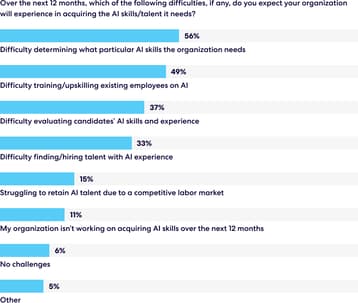
As AI use expands, organizations are discovering that identifying and developing the right skills is harder than adopting the technology itself. Many respondents expect their organization will struggle to determine what particular AI skills the organization needs (56%), to evaluate AI skills in new candidates (37%), and have difficulty training/upskilling their employees on AI (49%).
Rather than relying solely on new hires, many organizations are shifting their focus inward. Survey data shows that leaders overwhelmingly see upskilling existing employees as a critical need, especially as AI use cases continue to evolve.
This uncertainty is already changing how businesses think about hiring, onboarding, and performance evaluation, signaling a broader transformation of talent strategy, not just a change in job descriptions.
The most valuable capability isn’t technical; it’s human
While AI skills are in demand, leaders consistently emphasize the importance of human judgment, creativity, and domain expertise. As AI becomes more embedded in daily work, organizations increasingly value employees who know how and when to apply AI, not just how to operate it.
70% of those surveyed say AI is driving the need for their organization to find talent with the creativity, intuition, and discernment to work with AI. 52% prioritize industry experience over AI experience when hiring.
This shift reflects a growing recognition that AI works best when paired with human insight. Employees with deep industry knowledge and strong decision‑making skills are better equipped to spot AI’s limitations, manage risk, and apply outputs responsibly.
Together, these qualities point to the rise of the "wisdom worker." Employees who combine AI fluency with creativity, intuition, and sound judgment to guide better outcomes.
Rather than replacing human roles, AI is amplifying the importance of distinctly human capabilities, especially in fast‑moving business environments where adaptability matters.
of those surveyed say AI is driving the need for their organization to find talent with the creativity, intuition, and discernment to work with AI.
rank industry experience above AI experience.
What Businesses Are Asking
Yes. Over the next 12 months:
- 37% expect AI will alter the skills/experience they look for in candidates
- 33% expect AI will cause their organization to evaluate employee performance differently
- 33% expect AI will cause their organization to onboard talent differently
- 33% expect AI will cause their organization to find/acquire talent differently
AI is already reshaping how organizations assess and develop their people.
Stay ahead of the curve
Download The New Talent Playbook for Small and Midsize Businesses in the Age of AI from Harvard Business Review Analytic Services to gain insights on how AI is reshaping talent strategies—and discover what your organization can do to remain competitive.


